Past seminars
Archive of completed events. Times are Adelaide local (ACST/ACDT).
All past seminars
-
Special session
6 Oct 2026 · 14:30–15:30
- Speaker:
- Prof Lyle Palmer
- Date and Time:
- Tuesday 6 October 2026, 14:30–15:30 (Adelaide)
- Title:
- Probabilistic & Statistical Machine Learning
- Location:
- AIML Atrium
- Abstract:
- AIML Research Seminar. Format: AIML News, a short introduction by a senior academic, a student/postdoc presentation, Q&A, and afternoon tea. Talk title TBC.
-
GRS seminar
5 Oct 2026 · Break
- Speaker:
- —
- Date and Time:
- Monday 5 October 2026, Break (Adelaide)
- Title:
- Semester break
- Location:
- —
- Abstract:
- GRS Series — Week 11 of 15. No seminar this week (semester break).
-
GRS seminar
28 Sep 2026 · 13:00
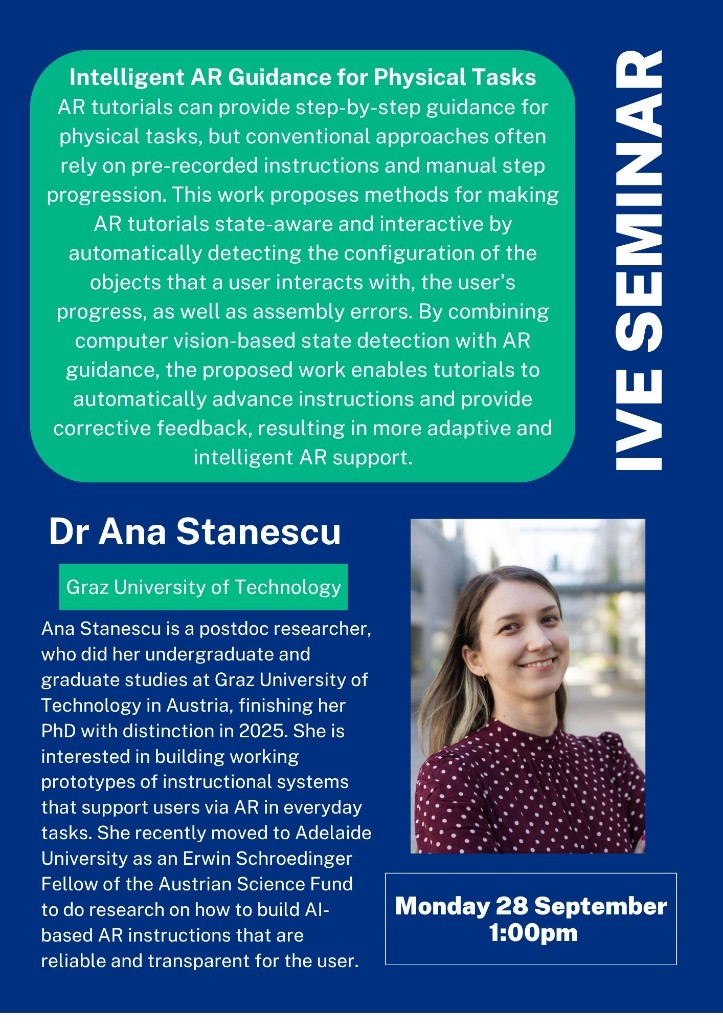
- Speaker:
- Dr Ana Stanescu, Graz University of Technology
- Date and Time:
- Monday 28 September 2026, 13:00 (Adelaide)
- Title:
- Intelligent AR Guidance for Physical Tasks
- Location:
- Online (Zoom)
- Abstract:
- GRS Series — Week 10 of 15 (online only; replacing Professor Claudia Szabo). The talk covers making AR tutorials state-aware and interactive instead of relying on pre-recorded steps and manual progression. The approach uses computer vision to detect object configuration, track user progress, and catch assembly errors, so the AR guidance can auto-advance instructions and give corrective feedback.
- Bio:
- Ana Stanescu is a postdoc researcher who did her undergraduate, graduate, and PhD (with distinction, 2025) at Graz University of Technology. She works on AR instructional systems for everyday tasks. She recently moved to Adelaide University as an Erwin Schroedinger Fellow of the Austrian Science Fund, researching reliable and transparent AI-based AR instructions.
- Online:
- Join online
-
Candidature review
25 Sep 2026 · 11:00–12:00
- Candidate:
- Adrian Chan
- Supervisor:
- Tat-Jun Chin
- Date and Time:
- Friday 25 September 2026, 11:00–12:00 (Adelaide)
- Title:
- Sensor Agnostic Object Instance Re-identification using Foundation Models
- Abstract:
- Hyperspectral imaging has unique capability to identify materials by their spectral signatures that can complement appearance-based spatial information for object instance re-identification (re-id). Currently no established pipeline or benchmark exists for hyperspectral re-id. In a security and surveillance context, a key challenge to take advantage of the heterogeneous hyperspectral sensors deployed is the ability to match query and gallery instances captured by different hyperspectral sensors that cover different wavelength regions and differ in the number of bands and band centres. We propose a two-stage sensor-agnostic pipeline for this task: 1) a zero-shot object detection stage, based on state-of-the-art Vision Foundation Models/Vision Language Models, operating on RGB-like image derived from the hyperspectral image-cube; followed by 2) a re-id feature extraction stage built on HyperFree (Li et al., 2025), a sensor-agnostic hyperspectral foundation model to pool per-pixel embeddings from detected objects into object-level feature vectors. As a proof of concept, we evaluate the feature extraction stage by itself using a multi-class classification proxy task and simulating different percentages of overlap between the wavelength regions covered by the query and gallery instances drawn from a single-sensor hyperspectral dataset. We compare the precision and recall of the feature extraction stage against a baseline that uses the pixel spectrum directly as the feature vector.
- Location:
- Online (Zoom; password 838912)
- Zoom:
- Join Zoom meeting
-
Candidature review
24 Sep 2026 · 13:00–14:00
- Candidate:
- Zhenlin Xu
- Supervisor:
- Lia Song, Xiaogang Zhu, Minhui Xue
- Date and Time:
- Thursday 24 September 2026, 13:00–14:00 (Adelaide)
- Title:
- Towards Robust Control Flow Security in LLM Agents
- Abstract:
- LLM agents increasingly rely on components such as memory, guardrails, and recovery mechanisms to support complex tasks, but these components can also introduce new risks to agent control flow, which refers to how an agent decides what to do next and in what order. This project investigates control flow security in LLM agents, focusing on three challenges: persistent manipulation through long term memory, unsafe behaviour reconstruction during recovery, and maintaining effective safety without unnecessarily blocking benign requests. By studying these challenges, this project aims to develop more robust and practical mechanisms for securing agent behaviour throughout the execution lifecycle.
- Location:
- Online (Zoom; password 030246)
- Zoom:
- Join Zoom meeting
-
Candidature review
24 Sep 2026 · 11:00–12:00
- Candidate:
- Chang Dong
- Supervisor:
- Minh Hoai Nguyen, Feras Dayoub, Francois Fraysse
- Date and Time:
- Thursday 24 September 2026, 11:00–12:00 (Adelaide)
- Title:
- Fine-Grained Action Counting and Quality Evaluation in Video
- Abstract:
- Fine-grained action understanding asks not only which action was performed but how well, and where it went wrong. Vision-language-action (VLA) policies have made robot manipulation broadly capable, yet their failures are still reduced to a scalar outcome and the trajectory is discarded. My research will investigate how embodied agents can identify, interpret, and learn from unsuccessful actions, organised around three questions: how to localise failure, how to recover from it, and how to learn from it. For the first, I developed a proprioception-guided failure diagnosis framework that localises when an execution begins to go wrong, together with a benchmark for evaluating it; results show that robot state carries temporal evidence that vision alone misses. Building on this diagnosis, the second stage studies correcting failures during execution rather than restarting the task, and the third turns failed experience into a learning signal for policy improvement while preserving the pretrained VLA's capabilities.
- Location:
- Online (Teams; passcode m9fb6yS3)
- Microsoft Teams meeting:
- Join Teams meeting
-
Special session
22 Sep 2026 · 14:30–15:30
- Speaker:
- Dr Arpit Garg
- Date and Time:
- Tuesday 22 September 2026, 14:30–15:30 (Adelaide)
- Title:
- AI Safety & Robustness / Trusted Autonomous Systems
- Location:
- AIML Atrium
- Abstract:
- AIML Research Seminar. Format: AIML News, a short introduction by a senior academic, a student/postdoc presentation, Q&A, and afternoon tea. Talk title TBC.
-
GRS seminar
21 Sep 2026 · 16:00–17:00

- Speaker:
- Dr Yuankai Qi, Macquarie University
- Date and Time:
- Monday 21 September 2026, 16:00–17:00 (Adelaide)
- Title:
- From Reasoning to Control: Distilling Control-Relevant Summaries via Latent Workspaces
- Location:
- CE: Ingkarni Wardli 5.57 (IW5.57); ML: Mawson Lakes Building J, J2-15
- Abstract:
- Explicit physical reasoning can improve policy learning in vision-language-action (VLA) models, but generating it at deployment adds inference cost. We propose a VLA framework that internalizes physical reasoning through control-summary self-distillation, enabling closed-loop control without explicit reasoning generation at deployment. Our framework learns from diverse physical reasoning in a modality-agnostic workspace and uses action supervision to shape what is transferred through its control summary. During self-distillation, a student uses only observations and instructions to match the control summary of a frozen teacher with access to explicit reasoning, without directly aligning their workspace states. Experiments on simulation benchmarks and real-world manipulation tasks show favourable performance compared to several state-of-the-art VLA methods, with average success rates of 98.6% on LIBERO, 73.2% on LIBERO-PLUS, and 77.3% across three real-world tasks. The deployed policy achieves an inference latency of 101 ms on an NVIDIA A100 GPU. Ablations further support the control summary as an effective target for transferring the benefits of physical reasoning to robot control.
- Bio:
- Dr Yuankai Qi is an ARC Future Fellow and Lecturer in Artificial Intelligence at Macquarie University. His research focuses on computer vision, multimodal learning, and embodied AI, with applications in robotics, medical imaging, and video understanding. He has published more than 80 papers in leading AI and computer vision venues, including CVPR, ICCV, ECCV, NeurIPS, AAAI, and IEEE TPAMI. His research has received several recognitions, including the ACM Multimedia 2024 Best Paper Award, ICPR 2024 Best Student Paper Award, and the CAAI Outstanding Doctoral Dissertation Award. He was also recognised among the Stanford/Elsevier World’s Top 2% Scientists in 2024 and 2025.
-
Candidature review
18 Sep 2026 · 10:30–11:30
- Candidate:
- Jialiang Li
- Supervisor:
- Mingyu Guo, Weitong Chen
- Date and Time:
- Friday 18 September 2026, 10:30–11:30 (Adelaide)
- Title:
- Parameterised and Learning-Augmented Algorithms for Real-World Optimisation
- Abstract:
- Combinatorial optimisation seeks the best combination of decisions under a given objective and set of constraints. For many computationally hard problems, exact algorithms can guarantee optimal solutions given sufficient time, but their computational cost can become prohibitive as problem size and complexity increase. This motivates methods that reduce computation while retaining the reliability required in practical decision-making. Machine learning offers promising opportunities to accelerate optimisation by exploiting patterns across problem instances, although learned methods often provide limited guarantees on solution quality and may generalise poorly when new instances differ from the training data. This research aims to develop practically effective optimisation methods that integrate algorithm design techniques with modern machine learning. A central component will be parameterised algorithms, which study computational complexity not only in terms of overall input size, but also through carefully chosen parameters that capture structural properties, characteristics of the desired solution, distance from tractable special cases, or other problem-specific features. This perspective can reveal tractable structure that is not captured by conventional complexity measures and enable algorithms tailored to practically relevant applications. Neural models will exploit common patterns to handle the routinely easier parts of the problem, leaving the instance-specific and computationally difficult parts to classical algorithms with reliability. Theoretical analysis will characterise these guarantees and the conditions under which the proposed methods are effective. In parallel, the research will identify and report machine-learning insights arising from this integration, including how learned models can exploit combinatorial structure, generalise across problem instances, and interact reliably with algorithmic components, thereby contributing broader insights to learning for optimisation. The proposed methods will be evaluated against established approaches on benchmark and realistic problem instances using various measures of solution quality, runtime, and other relevant performance metrics. The developed methods will also be applied directly to anatomical pathology workflow optimisation at SA Pathology, providing a real-world setting involving scheduling with uncertainty under constrained resources. The research will further consider optimisation challenges arising in large language model services and infrastructure, connecting the proposed methodology to rapidly evolving computational problems at the forefront of modern AI systems. Overall, the project seeks to establish broadly applicable principles for combining rigorous algorithm design with machine learning, enabling optimisation methods that are both computationally effective and dependable in practice.
- Zoom:
- Join Zoom meeting
-
Candidature review
15 Sep 2026 · 11:00
- Candidate:
- Qunchao Jin
- Supervisor:
- Lia Song, Qi Wu
- Date and Time:
- Tuesday 15 September 2026, 11:00 (Adelaide)
- Title:
- Multi-agent Vision-and-Language Navigation Based on Large Foundation Models
- Abstract:
- As multiple robots such as vacuums, delivery robots and assistant robots increasingly coexist in shared spaces, can Vision-Language Navigation (VLN) agents operating in the same environment benefit from each other's observations? Standard VLN systems are fundamentally constrained by partial observability, since each agent can only act based on what it has personally observed. We propose Co-VLN, a minimalist, model-agnostic framework in which independently tasked VLN agents detect spatial overlap and share their topological memory, effectively widening each agent's perceptual field without additional environment interaction. Across both learning-based and zero-shot VLN paradigms, peer observation yields consistent improvements, and our analyses reveal that the gains scale with scene complexity and the number of peers. Building on these findings, we are now exploring an extension to heterogeneous teams, whose members differ in sensing and locomotion capabilities.
- Location:
- Online (Zoom; password 12345)
- Zoom:
- Join Zoom meeting
-
GRS seminar
14 Sep 2026 · 16:00–17:00

- Speaker:
- Hu Wang, Khalifa University
- Date and Time:
- Monday 14 September 2026, 16:00–17:00 (Adelaide)
- Title:
- At the Intersection of Multi-modal Representation Learning and Large Models
- Location:
- CE: Ingkarni Wardli 5.57 (IW5.57); ML: Mawson Lakes Building J, J2-15
- Abstract:
- This talk explores the intersection of multi-modal representation learning and large models, with a focus on building robust, efficient, and adaptive AI systems. I will present our recent work on multi-modal learning, efficient vision-language models, and further discuss sequential decision making and reinforcement learning for large model reasoning. Together, these efforts point toward more capable multi-modal large models and self-evolving AI systems. I will also briefly share some information on the development of research, and higher education in the UAE universities, and the opportunities they offer for AI research and collaboration.
- Bio:
- I am an Assistant Professor at Khalifa University, which is currently ranked #147 in the QS World University Rankings. My research interests lie in language model reasoning, self-evolving and self-learning AI models, multi-agent systems, and representation learning. Before joining Khalifa University, I worked as an Assistant Professor of Practice and a Research Scientist at Mohamed bin Zayed University of Artificial Intelligence (MBZUAI). Prior to that, I worked as a Research Fellow at the Australian Institute for Machine Learning (AIML), University of Adelaide, where I also received my Ph.D. degree. My research has been published in leading conferences and journals, including CVPR, ECCV, ICCV, NeurIPS, IJCAI, AAAI, ACM MM, MICCAI, ICASSP, and ACM Computing Surveys. Website: https://huwang01.github.io/
-
Special session
8 Sep 2026 · 14:30–15:30
- Speaker:
- Dr Dino Sejdinovic (introduction); Erdun Gao (presentation)
- Date and Time:
- Tuesday 8 September 2026, 14:30–15:30 (Adelaide)
- Title:
- AI Safety & Robustness / Trusted Autonomous Systems
- Location:
- AIML Atrium
- Abstract:
- AIML Research Seminar. Format: AIML News, a short introduction by a senior academic, a student/postdoc presentation, Q&A, and afternoon tea. Talk titles TBC.
-
GRS seminar
7 Sep 2026 · 16:00–17:00

- Speaker:
- Professor Yuval Yarom
- Date and Time:
- Monday 7 September 2026, 16:00–17:00 (Adelaide)
- Title:
- Emergent behaviour in computer microarchitecture
- Location:
- CE: Ingkarni Wardli 5.57 (IW5.57); ML: Mawson Lakes Building J, J2-15
- Abstract:
- Modern CPUs consist of a large number of circuits, data structures and algorithms, collectively called the microarchitecture. Six decades of advances in microarchitectural design have yielded the highly optimised CPUs that drive our current, digital society. Although these optimisations are critical for computer performance, unintended interactions between microarchitectural components can leak sensitive information. Much effort has been invested into exploiting such emergent behaviour, identifying attacks and designing defences. In this talk we shift the focus to exploring the fundamental capabilities of this emergent behaviour. We discuss a recent construct called "weird gates" and examine its computational capabilities and temporal sensitivity. We demonstrate that weird gates allow arbitrary (Turing complete) computation on microarchitectural state and show their utility for various tasks, including overcoming defences, reverse engineering and code obfuscation.
- Bio:
- Yuval Yarom is a Professor of Computer Security at Ruhr University Bochum in Germany. His research focuses on the interface between the software and the hardware. In particular, He is interested in the discrepancy between the way that programmers think about software execution and the concrete execution in modern processors. He is a recipient of a 2020 ARC Discovery Early Career Award and the 2020 CORE Chris Wallace Award for Outstanding Research, a 2020 Young Tall Poppy. Previously, he has been an Associate Professor at the University of Adelaide, the Vice President of Research in Memco Software, and a co-founder and Chief Technology Officer of Girafa.com. Yuval earned his Ph.D. in Computer Science from the University of Adelaide in 2014, and an M.Sc. in Computer Science and a B.Sc. in Mathematics and Computer Science from the Hebrew University of Jerusalem in 1993 and 1990, respectively.
-
Candidature review
4 Sep 2026 · 10:00–11:00
- Candidate:
- Yvonne Lin
- Supervisor:
- Ivan Lee, Bruce Wedding, Lachlan Rudd
- Date and Time:
- Friday 4 September 2026, 10:00–11:00 (Adelaide)
- Title:
- Dynamic Safety and Quality Control in Hospitals Using Machine Learning: A Learning Health System Approach
- Abstract:
- Hospital quality improvement increasingly relies on learning from routinely collected health data. However, predictions, hospital benchmarks, anomaly alerts, and automated reporting become difficult to interpret when the comparative references behind each output are implicit, insufficiently supported, or inconsistent across different contexts. This limits their auditability and reduces confidence in translating analytical results into quality improvement decisions. Guided by the principles of Learning Health Systems, which transform routinely collected health data into evidence, action, and continuous organisational learning, this research aims to develop and validate an interpretability-centred hospital quality intelligence framework by integrating advanced computational methods, including explainable machine learning, graph-based modelling, uncertainty quantification, and schema-constrained language-model query planning. This framework aims to support improved patient safety and healthcare quality through effective patient references, fair and patient-relevant hospital comparisons, and reliable reporting. Its goal is to clearly identify uncertainties, enabling users to understand which patients and hospitals constitute each comparative reference, how conclusions were reached, and whether sufficient evidence exists before using this information for hospital quality assessments.
- Microsoft Teams meeting:
- Join Teams meeting
-
GRS seminar
31 Aug 2026 · 16:00–17:00

- Speaker:
- Professor Wolfgang Mayer
- Date and Time:
- Monday 31 August 2026, 16:00–17:00 (Adelaide)
- Title:
- AI and Software Engineering: When writing code is no longer the bottleneck
- Location:
- CE: Ingkarni Wardli 5.57 (IW5.57); ML: Mawson Lakes Building J, J2-15
- Abstract:
- The presentation explores how increasingly capable AI may reshape software engineering by focusing on three fundamental questions: If writing and rewriting code is no longer the bottleneck, what becomes the difficult part of software engineering? Do traditional concerns such as architecture, design, maintainability, and technical debt still matter when AI can change software at scale? And what does this shift mean for the skills and research problems that will matter in the future? Drawing on ideas from Brooks, Parnas, Dijkstra, Beck, Fowler, and Karpathy, the talk examines how AI shifts attention from producing code to determining what should be built, managing system-level consequences, and ensuring that generated solutions are appropriate and trustworthy.
- Bio:
- Professor Wolfgang Mayer's research combines machine learning, knowledge representation and semantic technologies to develop trustworthy AI for complex real-world systems. His research spans knowledge graphs, ontology engineering, few-shot and continual learning, reinforcement learning, natural language processing, digital twins and semantic interoperability. A central theme is the integration of data-driven and knowledge-driven AI to support reasoning and decision-making when data are heterogeneous, limited or distributed across organisational boundaries. His work is strongly application-oriented, with projects across Defence, advanced manufacturing, healthcare, engineering and asset management.
-
Special session
27 Aug 2026 · 14:30–15:30
- Speaker:
- Dr Na Zhao, Singapore University of Technology and Design
- Date and Time:
- Thursday 27 August 2026, 14:30–15:30 (Adelaide)
- Title:
- Beyond the 3D Data Bottleneck: Foundation Models as Teachers, Annotators, and Reasoners
- Location:
- CE-AIML-G.42 Atrium
- Abstract:
- 3D scene understanding and reasoning are limited less by architectures than by supervision. 3D annotation is slow and expensive, and the datasets we have remain orders of magnitude smaller than the image–text corpora that gave 2D vision and language models their open-world competence. The productive question, then, is what to borrow from foundation models, and how to route it into 3D. This talk traces that question through a series of our recent works, organized around a single observation in embodied AI. One ordinary instruction, such as "open the bottom drawer of the wooden cabinet with the flower vase on top", inherently demands four distinct capabilities: 1) recognizing categories outside the training vocabulary; 2) resolving which instance a description refers to; 3) reasoning about spatial arrangement; and 4) inferring how a part of an object can be acted upon. Across these works, 2D foundation models take on three roles. As teachers, they supply image-wise guidance and vision-language alignment for open-vocabulary 3D detection. As annotators, they synthesize diverse text–3D pairs that any existing 3D grounding method can consume. As reasoners, they operate directly over rendered viewpoints, replacing 3D-specific training with task-driven view selection to enable both spatial reasoning and fine-grained embodied reasoning, including predicting the location of affordance elements and how they move. Together, these works show which role a foundation model can usefully play in a given 3D task depending on where the bottleneck lies. I will close by looking ahead to instruction-driven embodied agents, and to the open challenges that stand in the way.
- Bio:
- Dr. Na Zhao is an Assistant Professor at the Singapore University of Technology and Design (SUTD), where she directs the Intelligent Machine Perception Lab (IMPL). She received her PhD in Computer Science from the National University of Singapore, where her thesis was awarded the 2021 IMDA Excellence Prize for Best PhD Thesis. Her research spans 3D computer vision, machine learning, and embodied AI, with the goal of building trustworthy autonomous systems that can perceive, reason, and act reliably in real-world applications, including robotics and autonomous driving. She has published 70+ papers in leading venues, including CVPR, ICCV, ECCV, NeurIPS, ICML, ICLR, AAAI, ICRA, IROS, IJCV, and TIP, and has attracted competitive research funding totaling over S$14M, including approximately S$4M as lead PI. She serves as an Associate Editor of IEEE Transactions on Circuits and Systems for Video Technology and Knowledge-Based Systems, and as an Area Chair or Senior Program Committee member for venues including NeurIPS, ICLR, ACM MM, AAAI, and IJCAI. She is General Co-Chair of the 33rd International Conference on Multimedia Modeling (MMM 2027), Diversity, Equity, and Inclusion Chair of the 36th ACM Web Conference (WWW 2027), and will serve as Technical Program Co-Chair of the 18th ACM International Conference on Multimedia Retrieval (ICMR 2028).
- Online:
- Join online
-
GRS seminar
24 Aug 2026 · 16:00–17:00
- Speaker:
- Spencer O'Keeffe (recent graduate presentation)
- Date and Time:
- Monday 24 August 2026, 16:00–17:00 (Adelaide)
- Title:
- Action Research with Industry
- Location:
- CE: Ingkarni Wardli 5.57 (IW5.57); ML: Mawson Lakes Building J, J2-15
- Abstract:
- Working with an industry partner provides researchers with domain expertise, relevant data, and tangible context for research projects, but brings a unique set of challenges. This talk will provide an overview of a PhD focused on immersive analytics in forestry, covering the action research methodology taken, how findings guided the research direction, opportunities arisen, and observations for new researchers engaging in industry partnered projects.
- Bio:
- Spencer O’Keeffe recently defended his PhD with the Wearable Computer Lab and the Forestry Centre of Excellence. His cross-disciplinary research spans Immersive Analytics and Forestry, exploring how extended reality, LiDAR, and advanced data visualisation can support decision-making, training, and planning in complex forestry systems. His work is conducted in close collaboration with industry partners, including OneFortyOne Mt Gambier. His current research interests include pine disease detection from LiDAR, machinery safety training in VR, and point clouds.
-
GRS seminar
24 Aug 2026 · 16:00–17:00
- Speaker:
- Dr Kaining Zhang (recent graduate presentation)
- Date and Time:
- Monday 24 August 2026, 16:00–17:00 (Adelaide)
- Title:
- Decoding Input Preferences and Switch-Intention from Implicit Signals
- Location:
- CE: Ingkarni Wardli 5.57 (IW5.57); ML: Mawson Lakes Building J, J2-15
- Abstract:
- Adaptive interactive systems need to understand not only what users are doing, but also how they experience and respond to different interaction methods. This research investigates whether physiological and behavioural signals can provide implicit evidence of users’ input preference and reported switch-intention, with a particular focus on augmented reality (AR) interaction. Across three empirical studies, we examine whether EEG can differentiate preferred and non-preferred hand-based input methods, whether preference-related EEG patterns remain detectable during realistic AR interaction, and whether multimodal signals, including EEG, eye gaze, and head movement, can predict users’ reported trial-level intention to switch input methods. The findings highlight the potential of implicit sensing for understanding dynamic user states during interaction and inform the design of more adaptive and user-centred interactive systems.
- Bio:
- Kaining Zhang is a Postdoctoral Teaching Fellow at Adelaide University and an HCI researcher working at the intersection of augmented and mixed reality, multimodal interaction, and implicit sensing. She recently passed her PhD defense, with her doctoral research investigating how physiological and behavioural signals, including EEG, eye gaze, and head movement, can be used to infer users’ input preferences and interaction intentions. Her broader research interests include adaptive and intelligent interactive systems, implicit user-state modelling, and interaction design for emerging computing environments. She is particularly interested in how interactive systems can better understand users and adapt to their changing needs while preserving user agency and control.
-
Special session
20 Aug 2026 · 10:30–11:30
- Speaker:
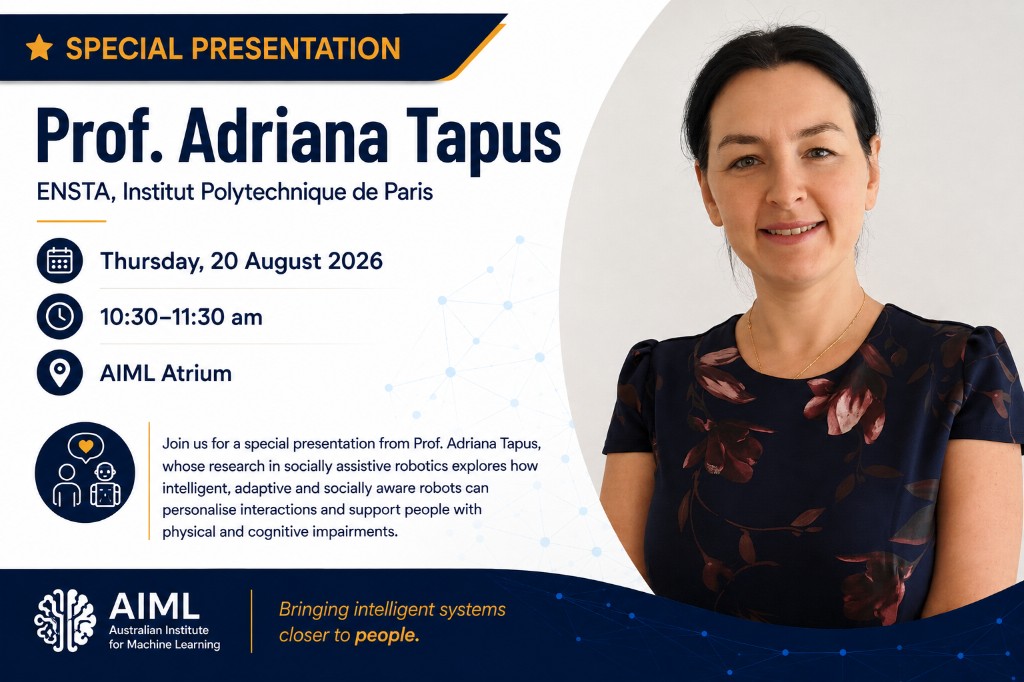
- Prof Adriana Tapus, ENSTA, Institut Polytechnique de Paris
- Date and Time:
- Thursday 20 August 2026, 10:30–11:30 (Adelaide)
- Title:
- Socially Assistive Robotics: Personalised and Adaptive Human–Robot Interaction
- Location:
- AIML Atrium (in-person) and Microsoft Teams
- Abstract:
- Join us for a special presentation by Prof. Adriana Tapus from ENSTA, Institut Polytechnique de Paris, a leading researcher in socially assistive robotics and human–robot interaction. Prof. Tapus’ research explores how intelligent robots can understand and adapt to individual users, combining verbal and nonverbal communication, user modelling and adaptive learning to create more personalised and socially aware interactions. Her work has particular applications in supporting people with physical and cognitive impairments, with the broader goal of developing robotic technologies that can meaningfully improve quality of life.
- Online:
- Join online
-
GRS seminar
17 Aug 2026 · 16:00–17:00

- Speaker:
- Professor Tat-Jun Chin
- Date and Time:
- Monday 17 August 2026, 16:00–17:00 (Adelaide)
- Title:
- Why do we publish?
- Location:
- CE: Ingkarni Wardli 5.57 (IW5.57); ML: Mawson Lakes Building J, J2-15
- Abstract:
- Many research students start their PhD journey by asking "how many papers do I need to publish to get the PhD". Similarly, many PhD supervisors set expectations in terms of the number of papers published, as well as the desired ranking of the publication venues (conferences, journals). At departmental and institutional levels, academic leaders use publication metrics to evaluate the performance of research groups and individual researchers. At governmental levels and society at large, academic league tables are often used to compare the performance of universities, and the publication statistics of an institution influence greatly the position of the institution in such rankings. With the current attitudes towards publishing entrenched and the "industry" of publishing strong and pervasive, there is the risk of losing sight of the reason for and the value of publishing towards scientific research. This talk aims to (re)ignite conversations on why we publish.
- Bio:
- Tat-Jun Chin is Professor of Computer Science at Adelaide University, where he leads the AI for Space Group. He received his PhD in Computer Systems Engineering from Monash University in 2007, which was partly supported by the Endeavour Australia-Asia Award, and a Bachelor in Mechatronics Engineering from Universiti Teknologi Malaysia in 2004, where he won the Vice Chancellor’s Award. Tat-Jun’s research interest lies in optimisation for computer vision and machine learning, and their application to intelligent satellites and space robotics. He has published more than 150 research articles on the subject, and has received multiple accolades for his research, including a CVPR award (2015), a BMVC award (2018), Best of ECCV (2018), three DST Awards (2015, 2017, 2021), an IAPR Award (2019), an RAL Best Paper Award (2021), and a nomination for ECCV Best Paper Award (2024). He was a Finalist in the Academic of the Year Category at Australian Space Awards 2021. Tat-Jun is currently Visiting Professor at the European Space Agency's Philab and was a SmartSat CRC Professorial Chair in 2020-2025.
- Online:
- Join online
-
Special session
13 Aug 2026 · 10:00
- Speaker:
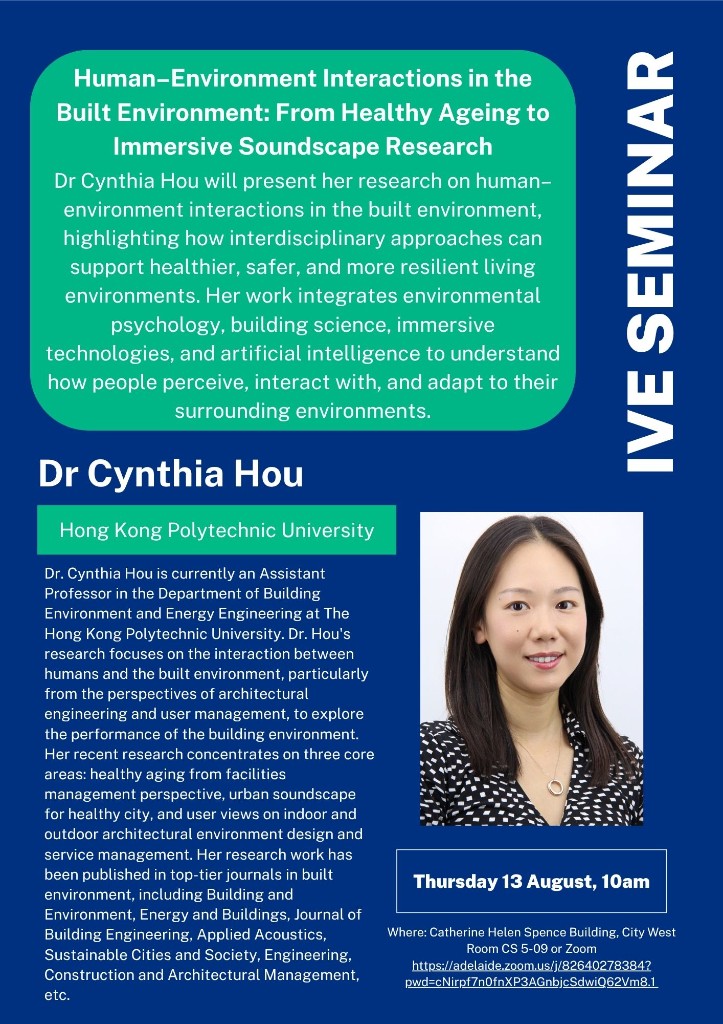
- Dr Cynthia Hou, The Hong Kong Polytechnic University
- Date and Time:
- Thursday 13 August 2026, 10:00 (Adelaide)
- Title:
- Human–Environment Interactions in the Built Environment: From Healthy Ageing to Immersive Soundscape Research
- Location:
- Catherine Helen Spence Building, City West Room CS 5-09
- Abstract:
- Dr Cynthia Hou will present her research on human–environment interactions in the built environment, highlighting how interdisciplinary approaches can support healthier, safer, and more resilient living environments. Her work integrates environmental psychology, building science, immersive technologies, and artificial intelligence to understand how people perceive, interact with, and adapt to their surrounding environments. Dr Hou is an Assistant Professor in the Department of Building Environment and Energy Engineering at The Hong Kong Polytechnic University. Her research focuses on the interaction between humans and the built environment, particularly from the perspectives of architectural engineering and user management. Her recent research concentrates on three core areas: healthy aging from facilities management perspective, urban soundscape for healthy city, and user views on indoor and outdoor architectural environment design and service management. She has been published in journals such as Building and Environment, Energy and Buildings, Journal of Building Engineering, Applied Acoustics, Sustainable Cities and Society, and Engineering, Construction and Architectural Management.
- Online:
- Join online
-
Special session
12 Aug 2026 · 11:00–12:00

- Speaker:
- A/Prof Hamid Rezatofighi, Monash University
- Date and Time:
- Wednesday 12 August 2026, 11:00–12:00 (Adelaide)
- Title:
- Neuro-Symbolic AI for Visual Reasoning and Robotic Systems: Building Trustworthy Intelligence
- Location:
- Online (Zoom)
- Abstract:
- Recent advances in vision-language and vision-language-action foundation models have transformed robotics, yet scaling neural models alone does not necessarily deliver the reasoning, interpretability, and safety assurance required for trustworthy autonomy. In this talk, I will present our research at Monash on neuro-symbolic AI, combining neural perception and grounding with explicit world representations, symbolic reasoning, and planning. I will briefly discuss our work on humanoid and human-centred robots and demonstrate this philosophy through our DARPA autonomous UAV system, which integrates perception, probabilistic world modelling, reasoning, and mission-level planning. I will then ask a deeper question: how far can neural scaling take us toward the reasoning required for embodied intelligence? Through VIEW2SPACE [ECCV’26], I will show limitations of state-of-the-art foundation models in multi-view visual reasoning, particularly as compositional complexity increases. I will conclude with our progression through HYDRA [ECCV’24], NAVER [ICCV’25], and MATA [ICLR’26] toward agentic neuro-symbolic visual reasoning that combines structured memory, explicit reasoning, specialised agents, and learned reasoning control. Dr. Hamid Rezatofighi is an Associate Professor in the Faculty of Information Technology at Monash University, Australia. His research spans computer vision, machine learning, robotics, and neuro-symbolic AI, with a particular focus on visual perception and reasoning for intelligent autonomous systems operating in complex, dynamic environments. His current research explores how neural foundation models can be integrated with symbolic reasoning and agentic planning to develop more capable, interpretable, and trustworthy embodied AI systems. Prior to joining Monash, he was awarded the prestigious Australian Government Endeavour Research Fellowship, supporting his research at Stanford University’s Vision and Learning Lab. He subsequently served as a Senior Research Fellow at the Australian Institute for Machine Learning (AIML), University of Adelaide, and received his PhD from the Australian National University in 2015. Dr. Rezatofighi has authored approximately 120 publications in top-tier venues across computer vision, machine learning, artificial intelligence, and robotics, attracting over 21,000 citations. His work on Generalized Intersection over Union (GIoU), introduced in 2019, has received over 9,300 citations and has been widely adopted in modern object detection systems. His research has attracted more than $18 million in competitive funding, including multiple DARPA projects (one as Lead PI) and an ARC Discovery Project as Lead CI. His research has been recognised through competitive awards including the U.S. Office of Naval Research Global-X Challenge Award as Lead PI, the Australian Government Endeavour Research Fellowship, and the Monash Faculty of IT Dean’s Award for Early Career Research Excellence. He is strongly committed to serving the international research community. Since 2020, he has regularly served as Area Chair or Lead Area Chair for major conferences including CVPR, NeurIPS, ECCV, ICCV, AAAI, and IJCAI. His broader community service includes Editor for IROS, Senior Associate Editor for IEEE Transactions on Image Processing, and Associate Editor for the Artificial Intelligence Journal and ICRA.
- Online:
- Join online
-
Special session
11 Aug 2026 · 14:30–15:30

- Speaker:
- Prof Anton van den Hengel
- Date and Time:
- Tuesday 11 August 2026, 14:30–15:30 (Adelaide)
- Title:
- Eyesight to the Blind
- Location:
- AIML Atrium (in-person) and Zoom
- Abstract:
- Can a machine learn to see before it has seen anything? This talk explores groundbreaking research showing how abstract procedural data gives AI the structural foundations for more efficient and capable learning. Transformers, like so many neural networks, are commonly initialised at random because we don't know what structure we actually want in the initial weights. Random initialisation is easy, and safe to the extent that it is unlikely to introduce unwanted bias. It represents a maximally unstructured starting point for gradient descent's search for the computational scaffolding it needs to begin learning semantics. This talk describes work showing that brief exposure to specific, abstract, procedurally generated data injects beneficial structural inductive biases directly into transformer weights before any semantic training begins. These biases are modular to the extent that they reside in identifiable architectural components, can be transferred independently, and compose across pretraining rules to jointly improve multiple capabilities. This process is modality-agnostic: a vision transformer warm-started on sequences of balanced brackets, and no images, gains +1.7% final performance on ImageNet-1k, outperforming baselines trained on visual synthetic data. We show that front-loading as little as 0.1% procedural tokens reduces the language modelling data budget by up to 45%. Pretraining on procedural data is thus far more effective than training on real data.
- Online:
- Join online
-
GRS seminar
10 Aug 2026 · 16:00–17:00
- Speaker:
- Ishara Udayanthi Hewa Pathiranage (student presentation)
- Date and Time:
- Monday 10 August 2026, 16:00–17:00 (Adelaide)
- Title:
- On the Use of Bi-Objective Evolutionary Algorithms for the Stochastic Multiple Knapsack Problem under Dynamic Constraints
- Location:
- CE: Napier 108; ML: Mawson Lakes Building J, J2-15
- Abstract:
- The multiple knapsack problem (MKP) generalizes the classical knapsack problem by assigning items to multiple knapsacks subject to capacity constraints. It is used to model many real-world resource allocation and scheduling problems. In practice, these optimization problems often involve stochastic and dynamic components. Evolutionary algorithms provide a flexible framework for addressing such problems under uncertainty and dynamic changes. In this paper, we investigate a stochastic and dynamic variant of MKP with chance constraints, where the item weights are modeled as independent normally distributed random variables and knapsack capacities change during the optimization process. We formulate the problem as a bi-objective optimization formulation that balances profit maximization and probabilistic capacity satisfaction at a given confidence level. We conduct an empirical comparison of four widely used multi-objective evolutionary algorithms (MOEAs), representing both decomposition- and dominance-based search paradigms. The algorithms are evaluated under varying uncertainty levels, confidence thresholds, and dynamic change settings. The results provide comparative insights into the behavior of decomposition-based and dominance-based MOEAs for stochastic MKP under dynamic constraints.
-
GRS seminar
10 Aug 2026 · 16:00–17:00
- Speaker:
- Naeem Paeedeh (student presentation)
- Date and Time:
- Monday 10 August 2026, 16:00–17:00 (Adelaide)
- Title:
- Learning Forever Across Varying Domains
- Location:
- CE: Napier 108; ML: Mawson Lakes Building J, J2-15
- Abstract:
- What if a neural network, the brain of an intelligence system, navigates an ever-changing world? While they can be trained to perform new tasks, they need to practice repeatedly or see a large number of samples. Moreover, as they continually learn new tasks, they forget most of the knowledge learned in past sessions. In this session, two novel methods will be discussed that help transformers efficiently learn new domains while preserving prior knowledge, without altering the networks' valuable original weights or storing any past samples. First, a novel method will be introduced that helps the network absorb both generalizable and shared knowledge across domains while also learning the nuances of each new domain. Second, a new method will be presented for an even more challenging setting of having a handful of samples by combining visual and linguistic knowledge of the world.
- Bio:
- Naeem is a PhD student in the School of Computer Science and IT. His research focuses on developing machine learning methods that enable neural networks to operate in dynamic environments with very limited labeled data. His interests are in few-shot learning, continual learning, domain adaptation, and vision-language models. He has developed transformer-based methods, the current dominant, most powerful yet data-hungry architecture of neural networks, to help them adapt rapidly from a few observations while becoming resilient to sudden and drastic shifts in the environment and to catastrophic forgetting.
-
Special session
7 Aug 2026 · 14:00
- Speaker:
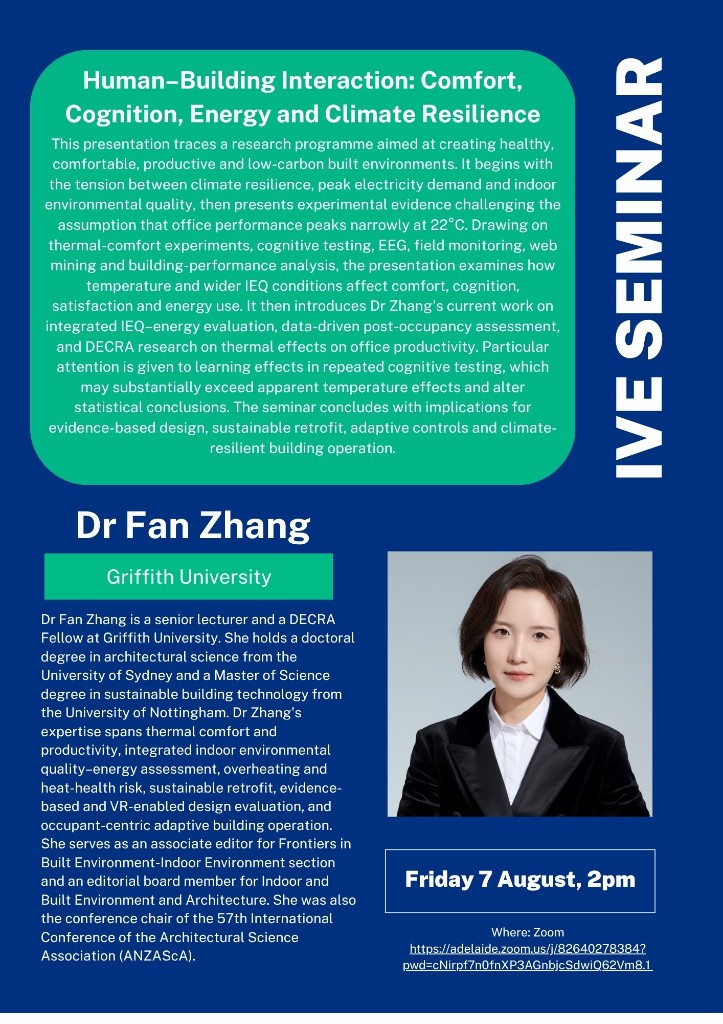
- Dr Fan Zhang, Griffith University
- Date and Time:
- Friday 7 August 2026, 14:00 (Adelaide)
- Title:
- Human–Building Interaction: Comfort, Cognition, Energy and Climate Resilience
- Location:
- Online (Zoom)
- Abstract:
- The talk covers a research programme on healthy, comfortable, productive, low-carbon built environments. It starts with the tension between climate resilience, peak electricity demand and indoor environmental quality, then presents experimental evidence challenging the assumption that office performance peaks narrowly at 22°C. It draws on thermal-comfort experiments, cognitive testing, EEG, field monitoring, web mining and building-performance analysis to examine how temperature and IEQ affect comfort, cognition, satisfaction and energy use. It also introduces Dr Zhang's current work on integrated IEQ-energy evaluation, data-driven post-occupancy assessment, and DECRA research on thermal effects on office productivity, with particular attention to learning effects in repeated cognitive testing that may exceed apparent temperature effects. It concludes with implications for evidence-based design, sustainable retrofit, adaptive controls and climate-resilient building operation. Dr Fan Zhang is a senior lecturer and DECRA Fellow at Griffith University. PhD in architectural science from the University of Sydney, MSc in sustainable building technology from the University of Nottingham. Expertise covers thermal comfort and productivity, integrated IEQ-energy assessment, overheating and heat-health risk, sustainable retrofit, evidence-based and VR-enabled design evaluation, and occupant-centric adaptive building operation. She is associate editor for Frontiers in Built Environment (Indoor Environment section) and editorial board member for Indoor and Built Environment and Architecture. She was conference chair of the 57th International Conference of the Architectural Science Association (ANZAScA).
- Online:
- Join online
-
Special session
4 Aug 2026 · 15:00
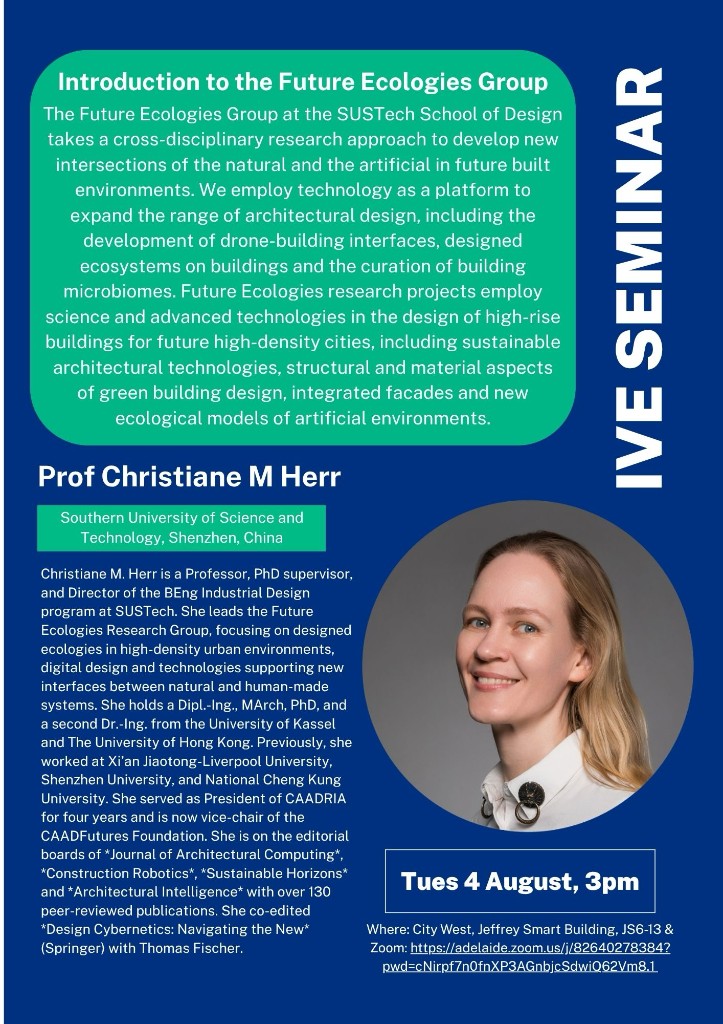
- Speaker:
- Prof Christiane M Herr, Southern University of Science and Technology, Shenzhen, China
- Date and Time:
- Tuesday 4 August 2026, 15:00 (Adelaide)
- Title:
- Introduction to the Future Ecologies Group
- Location:
- City West, Jeffrey Smart Building, JS6-13
- Abstract:
- The Future Ecologies Group at the SUSTech School of Design takes a cross-disciplinary research approach to develop new intersections of the natural and the artificial in future built environments. We employ technology as a platform to expand the range of architectural design, including the development of drone-building interfaces, designed ecosystems on buildings and the curation of building microbiomes. Future Ecologies research projects employ science and advanced technologies in the design of high-rise buildings for future high-density cities, including sustainable architectural technologies, structural and material aspects of green building design, integrated facades and new ecological models of artificial environments. Christiane M. Herr is a Professor, PhD supervisor, and Director of the BEng Industrial Design program at SUSTech. She leads the Future Ecologies Research Group, focusing on designed ecologies in high-density urban environments, digital design and technologies supporting new interfaces between natural and human-made systems. She holds a Dipl.-Ing., MArch, PhD, and a second Dr.-Ing. from the University of Kassel and The University of Hong Kong. Previously, she worked at Xian Jiaotong-Liverpool University, Shenzhen University, and National Cheng Kung University. She served as President of CAADRIA for four years and is now vice-chair of the CAADFutures Foundation. She is on the editorial boards of Journal of Architectural Computing, Construction Robotics, Sustainable Horizons and Architectural Intelligence with over 130 peer-reviewed publications. She co-edited Design Cybernetics: Navigating the New (Springer) with Thomas Fischer.
- Online:
- Join online
-
Special session
4 Aug 2026 · 14:30
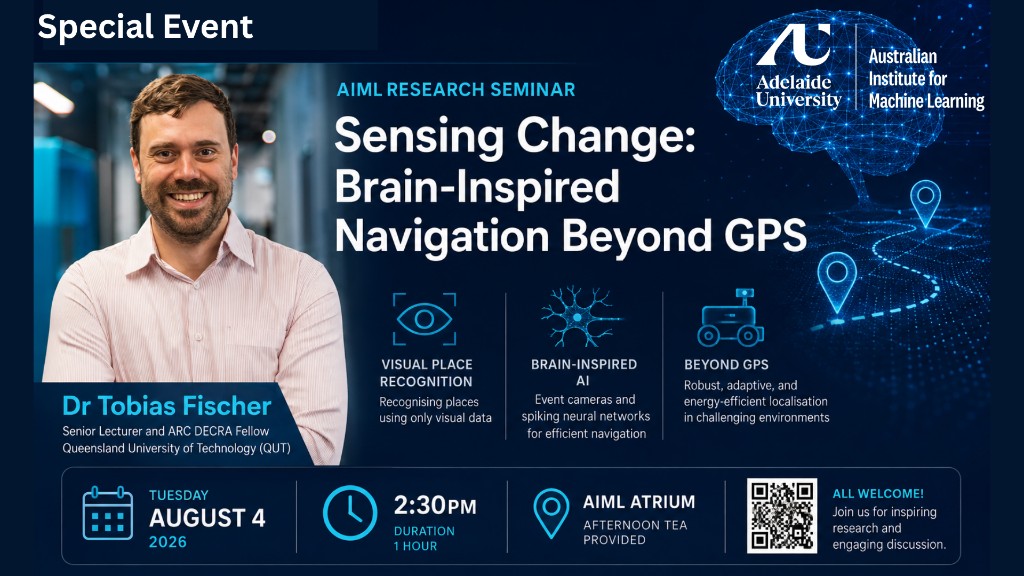
- Speaker:
- Dr Tobias Fischer, Queensland University of Technology
- Date and Time:
- Tuesday 4 August 2026, 14:30 (Adelaide)
- Title:
- Sensing Change: Brain-Inspired Navigation Beyond GPS
- Location:
- AIML Atrium (in-person) and Zoom
- Abstract:
- Knowing your location is fundamental to navigation - for humans, animals, and autonomous systems alike. But how can robots and other autonomous agents determine their position with confidence and precision in environments where satellite systems are unavailable or unreliable? The central theme of this talk explores Visual Place Recognition (VPR), which is the ability to recognise previously visited locations using only visual data. I will demonstrate how energy-efficient approaches using bio-inspired event-based cameras and spiking neural networks can provide low-power edge devices with location information with superior energy efficiency, adaptability, and data efficiency. Beyond this central theme, I will also touch on my work on underwater perception for reef restoration, and about Pixi, a powerful tool to run many robotics, computer vision, and AI libraries on any operating system (Linux, MacOS, Windows, or even your browser!). Dr Tobias Fischer is a Senior Lecturer and ARC DECRA Fellow at the Queensland University of Technology (QUT). His research spans neuromorphic computing, computer vision, and robotics, with a focus on robot localisation and underwater perception for resource-constrained autonomous systems. He has secured over $3 million in competitive research funding, including grants from Intel, Amazon, the Reef Restoration and Adaptation Program and a CRC-P with Emesent. Dr Fischer received his PhD from Imperial College London, where his thesis won the UK Best PhD in Robotics Award. He has published more than 70 papers in leading venues, including Science Robotics, IEEE Transactions on Robotics, IEEE Transactions on Pattern Analysis and Machine Intelligence, CVPR, ICCV, ECCV, ICRA, and IROS. He serves as an Associate Editor for leading robotics journals and conferences and co-chairs the IEEE Robotics and Automation Society Women in Engineering Committee. Website: https://www.tobiasfischer.info
- Online:
- Join online
-
Candidature review
4 Aug 2026 · 10:00–10:30
- Candidate:
- Nam Kha Nguyen
- Supervisor:
- Wei Zhang
- Date and Time:
- Tuesday 4 August 2026, 10:00–10:30 (Adelaide)
- Title:
- Generative Supervision for Modality Alignment in Vision-Language Models
- Abstract:
- Vision-language models align a frozen vision encoder to a language model using only a caption loss. Captions usually just describe the salient objects and omit texture, layout and fine attributes, so the encoder learns to discard the visual detail that many downstream tasks depend on. This project asks whether a generative model can supply a second, vision-grounded supervision signal during alignment which covers what the caption leaves out. It examines how such a signal should be built and conditioned so that it strengthens performance and the perception of visual detail, and then which kind of generative process delivers that signal most effectively.
- Microsoft Teams meeting:
- Join Teams meeting
-
GRS seminar
3 Aug 2026 · 16:00–17:00
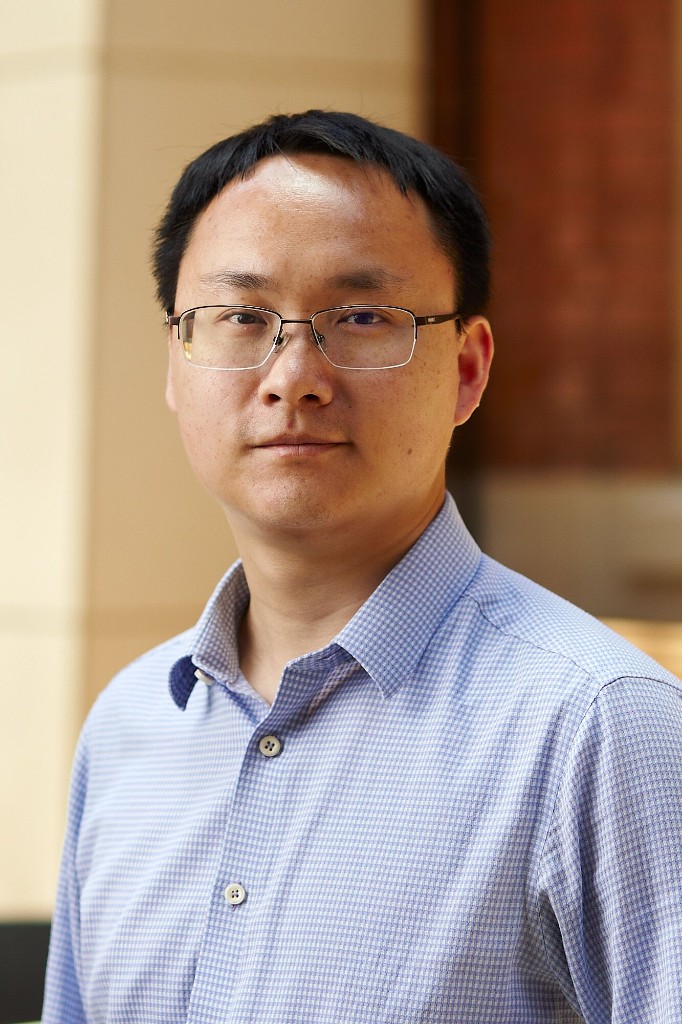
- Speaker:
- A/Prof Lingqiao Liu
- Date and Time:
- Monday 3 August 2026, 16:00–17:00 (Adelaide)
- Title:
- Learning Beyond Parameters: Optimising Prompts, Programmes, Workflows and Algorithms in the LLM Era
- Location:
- CE: Napier 108; ML: Mawson Lakes Building J, J2-15
- Abstract:
- The rapid advancement of large language models is transforming not only AI applications, but also what it means for a system to learn. While conventional machine learning focuses on parameter optimisation, modern LLM-based systems expose many additional components that can be optimised, including prompts, programmes, workflows and even algorithms. This seminar examines this shift through three questions: what to learn, how to learn, and what new capabilities this enables. Representative approaches across prompt optimisation, programme optimisation, workflow search and algorithm discovery will be discussed alongside techniques such as textual feedback, evolutionary search, tree search and self-improving agents. We conclude by outlining open challenges and opportunities for building AI systems that can improve not only models but entire problem-solving processes.
- Bio:
- Lingqiao Liu is an Associate Professor at the School of Computer Science, The University of Adelaide, Australia, and an Academic Member of the Australian Institute for Machine Learning. He received the ARC DECRA (Discovery Early Career Researcher Award) in 2016 and the University of Adelaide Research Fellowship in the same year. His research spans machine learning, computer vision, and natural language processing, with the objective of building practical machine learning systems that are more data efficient and generalisable for real-world applications. His current major research topics include low-supervision machine learning (semi-supervised learning, unsupervised learning, few-shot and zero-shot learning), generalisable machine learning systems (domain generalisation, compositional generalisation), computer vision applications (dense prediction, fine-grained recognition, content generation), and natural language processing applications (low-resource NLP and generalisation of NLP systems).
-
Special session
28 Jul 2026 · 14:30–15:30
- Speaker:
- Prof Weitong Chen (introduction); Liangwei Zheng (presentation)
- Date and Time:
- Tuesday 28 July 2026, 14:30–15:30 (Adelaide)
- Title:
- Large Language Models (LLMs)
- Location:
- AIML Atrium
- Abstract:
- AIML Research Seminar. Format: AIML News, a short introduction by a senior academic, a student/postdoc presentation, Q&A, and afternoon tea. Talk titles TBC.
-
GRS seminar
27 Jul 2026 · 16:00–17:00
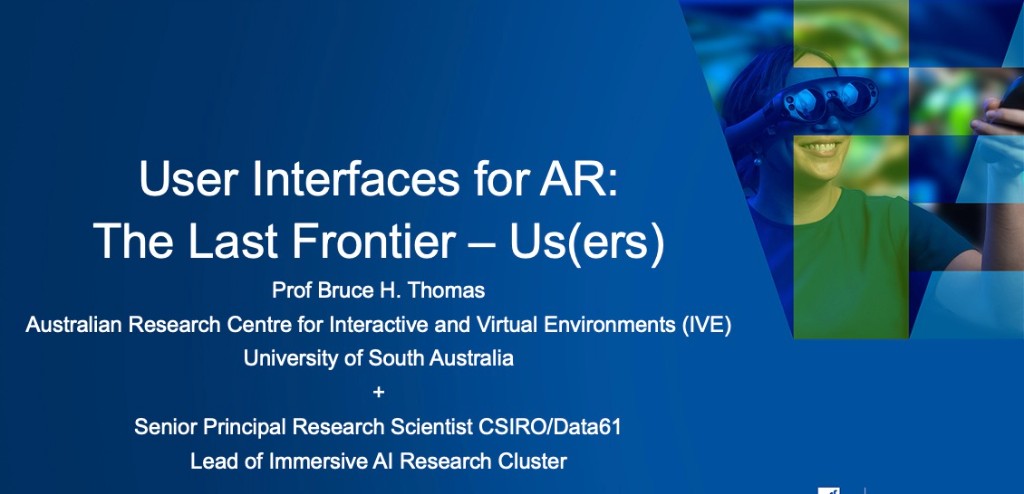
- Speaker:
- Prof Bruce H. Thomas
- Date and Time:
- Monday 27 July 2026, 16:00–17:00 (Adelaide)
- Title:
- User Interfaces for AR: The Last Frontier – Us(ers)
- Location:
- CE: Ingkarni Wardli 5.57 (IW5.57); ML: Mawson Lakes Building J, J2-15
- Abstract:
- User interfaces are the boundary between humans and Augmented Reality technology. These user interfaces incorporate the visual presentation of information, virtual controls for the applications, and physical devices to enhance users’ abilities to build a mental model that blends the physical world and the virtual world created for them. This is a very difficult problem to solve. Many smart scientists have investigated this problem for decades. This talk will investigate this research from the point of view of where we came from, where we are at the current moment, and possible future directions we could go. Part of this journey is a discussion of why this is a difficult problem. AR user interfaces are more difficult to design than traditional 2D desktops, handheld devices, and (I would argue) Virtual Reality interfaces. While AR user interfaces research is challenging, it is quite rewarding. The talk hopefully will motivate more researchers to investigate this topic.
- Bio:
- Professor Thomas is currently Emeritus Professor at the Adelaide University. His current research interests include the following: user interfaces, augmented reality, virtual reality, visualisation, wearable computers, CSCW, tabletop display interfaces, and the use of cognitive psychology in virtual environments research. He has served in many roles for the IEEE International Symposium on Mixed and Augmented Reality, IEEE Virtual Reality, and IEEE/ACM International Symposium on Wearable Computers, including program chair, general chair and on the steering committee. He also founded the ACM Interactive Surfaces and Spaces Conference (formerly IEEE Tabletop). He was awarded the ACM International Symposium on Wearable Computers (ISWC) 20-Year Impact Award. Prof. Thomas’ academic qualifications include the following: a BA in Physics from George Washington University, an MS in Computer Science from the University of Virginia, and a PhD in Computer Science from Flinders University.
-
Thesis defence (public seminar)
16 Jul 2026 · 15:20
- Candidate:
- Gengze Zhou
- Supervisor:
- A/Prof Qi Wu, Dr Yicong Hong
- Date and Time:
- Thursday 16 July 2026, 15:20 (Adelaide)
- Title:
- Embodied World Knowledge for Vision-and-Language Navigation: Reasoning, Grounding, and Generalisation with Multimodal Large Language Models
- Abstract:
- Vision-and-Language Navigation requires an embodied agent to interpret natural-language instructions, understand complex visual environments, reason about spatial relationships, and execute a sequence of actions to reach a target destination. Although substantial progress has been made, conventional navigation systems often rely on task-specific architectures and limited supervision, restricting their ability to generalise to unseen environments, instructions, and navigation objectives. This thesis investigates how multimodal large language models can equip embodied agents with richer world knowledge, stronger reasoning capabilities, and improved visual-language grounding. It introduces a series of methods that integrate pretrained vision-language representations, large language model reasoning, environmental memory, and navigation-specific action learning. These methods address key challenges including instruction understanding, object and landmark grounding, long-horizon planning, continuous-environment navigation, and generalisation across tasks and environments. The thesis also examines a broader agentic formulation of embodied navigation, in which high-level reasoning and planning are separated from low-level navigation execution. Within this framework, a general-purpose agent can interpret user goals, decompose complex tasks, maintain and retrieve relevant environmental evidence, and coordinate specialised navigation and perception components. This separation enables the reasoning layer to flexibly select behaviours, manage contextual information, and adapt the system to different tasks without requiring every capability to be incorporated into a single monolithic model. Overall, the research demonstrates that combining large-scale vision-language pretraining, explicit embodied alignment, structured memory, and agentic planning can substantially improve navigation performance, robustness, and generalisation. These findings provide a scalable foundation for developing general-purpose embodied agents capable of understanding instructions, reasoning about their surroundings, and acting effectively in complex simulated and real-world environments.
- Location:
- City East, Napier Building, 209 Lecture Theatre
-
Thesis defence (public seminar)
16 Jul 2026 · 15:20
- Candidate:
- Kaining Zhang
- Supervisor:
- Prof Mark Billinghurst, Dr Theophilus Teo, Dr Allison Jing
- Date and Time:
- Thursday 16 July 2026, 15:20 (Adelaide)
- Title:
- Decoding Input Preferences and Switch-Intention from Implicit Signals
- Abstract:
- This thesis presents an implicit sensing framework for investigating how physiological and behavioural signals can be used to infer input preference and reported switch-intention in interaction tasks, with a focus on augmented reality (AR) interaction. Across three empirical studies, the thesis examines EEG-based differentiation between preferred and non-preferred hand-based input methods, validates EEG-based preference prediction in realistic AR interaction, and explores a multimodal implicit-signal method for predicting reported trial-level switch-intention using EEG, eye gaze, and head movement signals. This research provides methodological and design insights for developing more adaptive and user-centred AR interaction systems.
- Location:
- Mawson Lakes, Building H, Level 1, Room 42
-
Thesis defence (public seminar)
15 Jul 2026 · 09:20–10:00
- Candidate:
- Sindy Pinero
- Supervisor:
- A/Prof Thuc Duy Le
- Date and Time:
- Wednesday 15 July 2026, 09:20–10:00 (Adelaide)
- Title:
- Causal Frameworks for Biomarker Discovery, Early Detection, and Drug Repurposing in Long COVID
- Abstract:
- Post-Acute Sequelae of SARS-CoV-2 infection (PASC), commonly known as Long COVID, is a major global health challenge that affects a substantial proportion of individuals after infection and imposes high economic costs on healthcare systems and society. Despite extensive research, no disease-modifying therapy has received regulatory approval, and clinical care remains largely focused on symptoms. Progress has been slowed by three linked problems. First, the molecular signals reported across omics studies are difficult to interpret because association-based findings cannot reliably distinguish causal disease mechanisms from downstream responses or confounded correlates. Second, current diagnostic practice is retrospective and symptom-based, which limits the ability to identify high-risk individuals before persistent symptoms develop. Third, drug development pipelines treat safety as a downstream filter rather than a primary selection criterion, which is poorly suited to the heterogeneous, multimorbid populations affected by Long COVID. Addressing these problems requires moving from descriptive omics databases toward a coherent, causally aware analytical pipeline. The general aim of this thesis is to develop and apply computational frameworks that link omics evidence to causal biomarker discovery, presymptomatic risk prediction, and safety-first therapeutic deprioritisation on Long COVID. This aim is pursued through four objectives, each mapped to one of the above problems. The first objective focuses on the interpretability problem at the level of evidence from the literature, by establishing what is currently known from omics research on Long COVID and assessing the reliability of this evidence. The second objective continues to address the interpretability problem at the level of target discovery, by determining whether gene expression signatures can be linked to Long COVID susceptibility in a way that separates mechanistic drivers from downstream or confounded correlates. The third objective addresses the early-detection problem by testing whether early molecular profiles captured during acute infection can predict future Long COVID risk before symptom onset. The fourth objective addresses the safety problem in drug repurposing by developing a therapeutic deprioritisation framework that integrates causal target evidence with safety-first reasoning. To meet these objectives, this thesis develops four computational contributions. The first is a systematic critical review of 101 Long COVID omics studies that identify reproducible biological signals and articulate the methodological gaps that constrain translation. The second is MRCONTROL, an integrative framework that combines two complementary causal inference strategies to prioritise causal genes and stratify patients into transcriptomic endotypes. The third is TACO, a presymptomatic detection framework that combines causal feature selection with foundation-model classification to detect Long COVID at an early stage. The fourth is SPLIT, a drug repurposing framework that integrates three causal inference strategies with clinical knowledge graph learning to classify drug candidates based on predicted safety across different cohorts of Long COVID. Together, these contributions advance both the methodology and the translational evidence for Long COVID, providing causally grounded biomarkers, an early-detection model suitable for the acute infection window, and a phenotype-aware safety screening tool. The integrated workflow also provides a reusable template for other complex chronic conditions characterised by heterogeneity, comorbidity, and limited validated therapeutic targets.
- Location:
- Mawson Lakes, Building H, Level 1, Room 42
-
Special session
30 Jun 2026 · 10:30–11:15

- Speaker:
- Nguyen Huu Thanh and Nguyen Tai Hung, Advanced Networking and Smart Applications Laboratory (ANSA), School of Electrical and Electronic Engineering, Hanoi University of Science and Technology, Vietnam
- Date and Time:
- Tuesday 30 June 2026, 10:30–11:15 (Adelaide)
- Title:
- Building Sustainable Smart Cities with AI-as-a-Service on Cloud and Edge Platforms
- Location:
- AIML Atrium (in-person) and Zoom
- Abstract:
- Join us for a special AIML Research Seminar with Nguyen Huu Thanh and Nguyen Tai Hung from Hanoi University of Science and Technology as they explore how AI-as-a-Service, cloud-edge computing, and distributed AI are enabling the development of sustainable, intelligent smart cities through scalable, energy-efficient, and real-time AI solutions. In person at the AIML Atrium; morning tea provided. Artificial Intelligence (AI) is becoming a key enabler of digital transformation and smart city development. However, the rapid growth of AI applications generates unprecedented demands on computing, communication, and energy resources, raising important challenges related to scalability, latency, privacy, and sustainability. This talk presents cloud and edge computing infrastructures as a foundation for delivering sustainable AI services in smart city environments. In this talk, we first discuss emerging distributed AI paradigms, including federated learning, model parallelism, and hybrid parallelism, that enable AI training and inference across heterogeneous edge-cloud resources while reducing communication overhead and preserving data privacy. The concept of AI-as-a-Service is then introduced, integrating distributed AI, edge/cloud computing, and advanced communication networks to support dynamic provisioning of AI services. Attention is given to resource-aware orchestration, containerized service deployment, and energy-efficient management of computing resources. The talk further presents a recent research project on a real-world smart city case study involving large-scale traffic camera networks to illustrate how sustainable AI services can be deployed efficiently, achieving improved resource utilization, reduced energy consumption, and enhanced real-time performance.
- Online:
- Join online
-
Candidature review
26 Jun 2026 · 10:30
- Candidate:
- Xiaoyang Li
- Supervisor:
- Wei Zhang
- Date and Time:
- Friday 26 June 2026, 10:30 (Adelaide)
- Title:
- Time Series Forecasting under Data Heterogeneity
- Abstract:
- Time series forecasting aims to predict future values or uncertainty from historical temporal observations, but real-world time series are often heterogeneous across time, data sources, and external modalities. This project investigates time series forecasting under data heterogeneity, focusing on three challenges: robustness under temporal distribution shift, generalization across structurally heterogeneous sources, and alignment of multimodal information with numerical time series. By developing heterogeneity-aware and uncertainty-aware forecasting methods, this project aims to support more robust, transferable, and interpretable forecasting in complex real-world settings.
- Microsoft Teams meeting:
- Join Teams meeting
-
Special session
16 Jun 2026 · 10:30
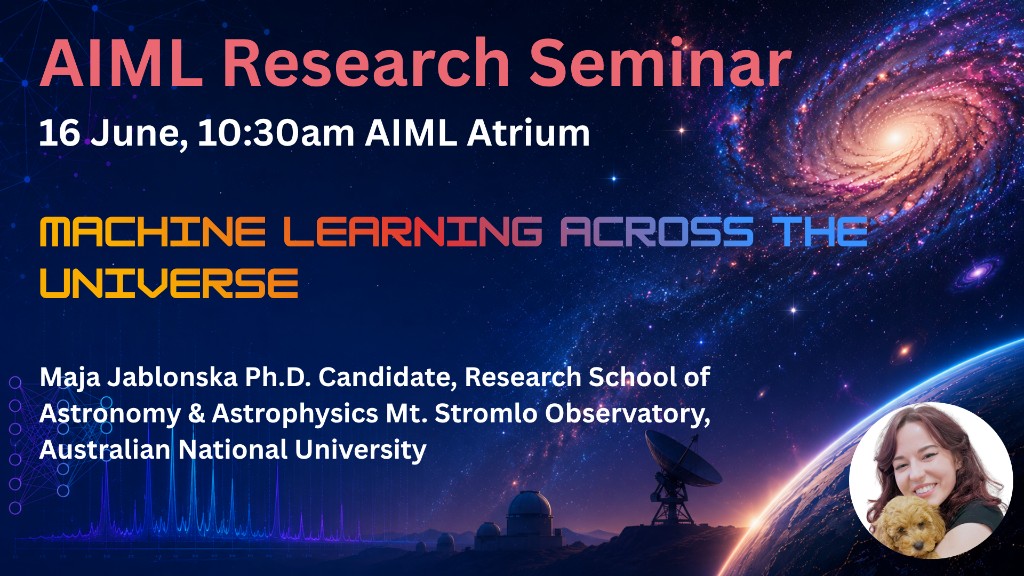
- Speaker:
- Maja Jablonska
- Date and Time:
- Tuesday 16 June 2026, 10:30 (Adelaide)
- Title:
- Machine Learning Across the Universe
- Location:
- AIML Atrium (in-person) and Zoom
- Abstract:
- Astronomy and physics deal with various problems that can be excellently advanced by machine learning — most commonly due to enormous data volumes, computationally intensive forward models, and complex inference tasks involved. In this talk, Maja will provide an overview of the persistent challenges in astrophysics and highlight recent advances in applying machine learning, including spectral synthesis and analysis, mechanistic interpretability for testing the Platonic hypothesis in astronomical data, and hypothesis generation. She will also examine the limitations of current methods, with particular attention to factors that may hinder the broader adoption of machine learning in astrophysics.
- Online:
- Join online
-
Special session
29 May 2026 · 16:00–17:00
- Speaker:
- Dr Dooyoung Kim, La Trobe University
- Date and Time:
- Friday 29 May 2026, 16:00–17:00 (Adelaide)
- Title:
- Connecting Intelligences beyond Boundaries
- Location:
- Online (Zoom)
- Abstract:
- This talk explores how XR and spatial computing can connect people, AI, and memories beyond the boundaries of virtual and physical worlds, distance, and time. The presentation covers research on MR telepresence, virtual-physical integration, Physical AI and digital twins, and XRMemory systems for capturing, reconstructing, and replaying spatial experiences. Dr Dooyoung Kim is an incoming Lecturer in the Department of Computer Science and Information Technology at La Trobe University. He received his Ph.D. in Culture Technology from the KAIST UVR Lab, was a visiting postdoctoral researcher at New York University, and previously served as a Senior Researcher at the KAIST Augmented Reality Research Center. His research focuses on XR, spatial computing, and Human-Computer Interaction. He has received three ISMAR Best Paper Awards, an ACM CHI Honorable Mention Award, and has served as an organizer and session chair for IEEE VR and IEEE ISMAR.
- Online:
- Join online
-
Candidature review
13 May 2026 · 13:00–14:00
- Candidate:
- Chuhan Wang
- Supervisor:
- Prof. Olaf Maennel and Prof. Ruidong Chang
- Date and Time:
- Wednesday 13 May 2026, 13:00–14:00 (Adelaide)
- Title:
- Towards Reliable Digital Twin State: Definition, Maintenance, and Use under Imperfect Sensing
- Abstract:
- Digital Twin (DT) systems for the building environment promise continuous, model-based insight into the condition of buildings and infrastructure. However, the sensing data that drives these systems is noisy, intermittent, and heterogeneous and most existing frameworks respond by treating sensor observations directly as system state in practice. This leads to various instability: transient objects corrupt geometric models, sensor failures leave the state undefined, and residual uncertainty propagates unchecked to downstream monitoring and maintenance decisions etc. This research proposes a state-centric perspective for DT systems, in which system state is an explicitly defined, continuously maintained, and reliably construct from but not equate with sensor observations. A unified three-module framework is developed to address the full state lifecycle under imperfect sensing: (1) a geometric state definition module that infers persistent structural state from multi-temporal LiDAR point clouds and images, distinguishing permanent features from transient elements; (2) a state maintenance module that coordinates heterogeneous IoT sensor streams, identify sensor reliability, and resolves inter-sensor conflicts to produce a trusted Digital Twin state; (3) a decision module that formulates resource-constrained maintenance and sensing strategies, accounting for residual state uncertainty. The framework is validated using data from an ARC-funded large-scale IoT deployment across residential buildings, providing real-world conditions of sensing noise, heterogeneity, and long-term operation. Expected contributions include a conceptual framework for state-centric Digital Twins, and an empirically validated system demonstrating practical deployability. This research addresses a cross-domain gap identified across geometric modeling, multi-sensor integration, and reliability-aware decision-making literature.
- Location:
- Ingkarni Wardli 4.63 (IW 4.63) — also available via Teams
- Microsoft Teams meeting:
- Join Teams meeting
-
Candidature review
13 May 2026 · 10:00–11:00
- Candidate:
- Ziyang Ye
- Supervisor:
- Prof Olaf Maennel
- Date and Time:
- Wednesday 13 May 2026, 10:00–11:00 (Adelaide)
- Title:
- Towards Secure and Robust Visual Intelligence: Adversarial Robustness in Vision Foundation Models
- Abstract:
- Vision Foundation Models are increasingly becoming the backbone of modern visual intelligence, enabling a wide range of systems to perceive, interpret, and reason about visual information. Their growing reuse across different applications brings significant benefits in generalisation and transferability, but it also introduces a new security concern: adversarial vulnerabilities may no longer be confined to individual models or isolated tasks. Instead, weaknesses in shared visual representations may transfer across model families and propagate through downstream systems, creating broader risks for the visual intelligence ecosystem. This research investigates the adversarial robustness of vision foundation models as a core AI security problem. It aims to understand how adversarial vulnerabilities emerge, how they transfer across different models and learning paradigms, and how they affect systems built upon shared visual backbones. It also examines whether current defence mechanisms are sufficient under stronger and more systematic evaluation, and explores the trade-off between improving robustness and preserving the generalisation capabilities that make foundation models valuable. Through a comparative and system-oriented methodology, this study will evaluate robustness at multiple levels, from foundation representations to downstream system behaviour, using a range of adversarial settings and defence strategies. The expected outcome is a more unified understanding of vulnerability propagation, defence limitations, and robustness–generalisation trade-offs, contributing to the development of more secure and reliable visual intelligence systems.
- Microsoft Teams meeting:
- Join Teams meeting
-
Candidature review
24 Apr 2026 · 15:00
- Candidate:
- Simranjeet Singh Dahia
- Supervisor:
- Prof Claudia Szabo, Dr Ruslan Puscasu, Dr Azhar Iqbal
- Date and Time:
- Friday 24 April 2026, 15:00 (Adelaide)
- Title:
- Quantum multi-agent reinforcement learning for decision-making in complex systems
- Abstract:
- Multi-agent reinforcement learning is a natural framework for decentralised decision-making in complex systems, but it faces persistent challenges under partial observability, strong inter-agent coupling and increasing coordination complexity. Quantum multi-agent reinforcement learning (QMARL) has recently emerged as a possible way to enhance policy and value representations in such settings. However, the field remains methodologically fragmented, is dominated by hybrid simulation-based studies and lacks both a consistent operational definition and disciplined evaluation standards. Our systematic review found that most existing work concentrates on encoding and policy approximation, while learning, coordination and evaluation remain underdeveloped. This PhD investigates QMARL as a representational framework rather than a computational speedup claim. We established a centralized-training, decentralized-execution QMARL pipeline, implemented matched quantum-classical benchmarking and introduced a Dec-POMDP calibration benchmark to test whether the framework can resolve non-classical correlation structure. Building on this foundation, ongoing experiments in cooperative MARL environments examine when quantum-parameterized actors and critics remain competitive and when stronger coordination regimes begin to expose representation-dependent behaviour. These findings motivate the next stage of the project: a complex phase space representation designed to explicitly encode coordination-relevant dynamics and a conflict-aware stabilisation mechanism for more expressive modelling of complex multi-agent dynamics.
- Microsoft Teams meeting:
- Join Teams meeting
-
Special session
10 Mar 2026 · 14:00
- Speaker:
- Panel (CSIT GRS)
- Date and Time:
- Tuesday 10 March 2026, 14:00 (Adelaide)
- Title:
- Industry collaboration and IP — panel discussion
- Location:
- Ingkarni Wardli, Level 4 seminar room
- Abstract:
- Special session with industry partners on collaboration models, intellectual property, and commercialisation pathways for GRS research.
Candidature review
-
Candidature review
25 Sep 2026 · 11:00–12:00
- Candidate:
- Adrian Chan
- Supervisor:
- Tat-Jun Chin
- Date and Time:
- Friday 25 September 2026, 11:00–12:00 (Adelaide)
- Title:
- Sensor Agnostic Object Instance Re-identification using Foundation Models
- Abstract:
- Hyperspectral imaging has unique capability to identify materials by their spectral signatures that can complement appearance-based spatial information for object instance re-identification (re-id). Currently no established pipeline or benchmark exists for hyperspectral re-id. In a security and surveillance context, a key challenge to take advantage of the heterogeneous hyperspectral sensors deployed is the ability to match query and gallery instances captured by different hyperspectral sensors that cover different wavelength regions and differ in the number of bands and band centres. We propose a two-stage sensor-agnostic pipeline for this task: 1) a zero-shot object detection stage, based on state-of-the-art Vision Foundation Models/Vision Language Models, operating on RGB-like image derived from the hyperspectral image-cube; followed by 2) a re-id feature extraction stage built on HyperFree (Li et al., 2025), a sensor-agnostic hyperspectral foundation model to pool per-pixel embeddings from detected objects into object-level feature vectors. As a proof of concept, we evaluate the feature extraction stage by itself using a multi-class classification proxy task and simulating different percentages of overlap between the wavelength regions covered by the query and gallery instances drawn from a single-sensor hyperspectral dataset. We compare the precision and recall of the feature extraction stage against a baseline that uses the pixel spectrum directly as the feature vector.
- Location:
- Online (Zoom; password 838912)
- Zoom:
- Join Zoom meeting
-
Candidature review
24 Sep 2026 · 13:00–14:00
- Candidate:
- Zhenlin Xu
- Supervisor:
- Lia Song, Xiaogang Zhu, Minhui Xue
- Date and Time:
- Thursday 24 September 2026, 13:00–14:00 (Adelaide)
- Title:
- Towards Robust Control Flow Security in LLM Agents
- Abstract:
- LLM agents increasingly rely on components such as memory, guardrails, and recovery mechanisms to support complex tasks, but these components can also introduce new risks to agent control flow, which refers to how an agent decides what to do next and in what order. This project investigates control flow security in LLM agents, focusing on three challenges: persistent manipulation through long term memory, unsafe behaviour reconstruction during recovery, and maintaining effective safety without unnecessarily blocking benign requests. By studying these challenges, this project aims to develop more robust and practical mechanisms for securing agent behaviour throughout the execution lifecycle.
- Location:
- Online (Zoom; password 030246)
- Zoom:
- Join Zoom meeting
-
Candidature review
24 Sep 2026 · 11:00–12:00
- Candidate:
- Chang Dong
- Supervisor:
- Minh Hoai Nguyen, Feras Dayoub, Francois Fraysse
- Date and Time:
- Thursday 24 September 2026, 11:00–12:00 (Adelaide)
- Title:
- Fine-Grained Action Counting and Quality Evaluation in Video
- Abstract:
- Fine-grained action understanding asks not only which action was performed but how well, and where it went wrong. Vision-language-action (VLA) policies have made robot manipulation broadly capable, yet their failures are still reduced to a scalar outcome and the trajectory is discarded. My research will investigate how embodied agents can identify, interpret, and learn from unsuccessful actions, organised around three questions: how to localise failure, how to recover from it, and how to learn from it. For the first, I developed a proprioception-guided failure diagnosis framework that localises when an execution begins to go wrong, together with a benchmark for evaluating it; results show that robot state carries temporal evidence that vision alone misses. Building on this diagnosis, the second stage studies correcting failures during execution rather than restarting the task, and the third turns failed experience into a learning signal for policy improvement while preserving the pretrained VLA's capabilities.
- Location:
- Online (Teams; passcode m9fb6yS3)
- Microsoft Teams meeting:
- Join Teams meeting
-
Candidature review
18 Sep 2026 · 10:30–11:30
- Candidate:
- Jialiang Li
- Supervisor:
- Mingyu Guo, Weitong Chen
- Date and Time:
- Friday 18 September 2026, 10:30–11:30 (Adelaide)
- Title:
- Parameterised and Learning-Augmented Algorithms for Real-World Optimisation
- Abstract:
- Combinatorial optimisation seeks the best combination of decisions under a given objective and set of constraints. For many computationally hard problems, exact algorithms can guarantee optimal solutions given sufficient time, but their computational cost can become prohibitive as problem size and complexity increase. This motivates methods that reduce computation while retaining the reliability required in practical decision-making. Machine learning offers promising opportunities to accelerate optimisation by exploiting patterns across problem instances, although learned methods often provide limited guarantees on solution quality and may generalise poorly when new instances differ from the training data. This research aims to develop practically effective optimisation methods that integrate algorithm design techniques with modern machine learning. A central component will be parameterised algorithms, which study computational complexity not only in terms of overall input size, but also through carefully chosen parameters that capture structural properties, characteristics of the desired solution, distance from tractable special cases, or other problem-specific features. This perspective can reveal tractable structure that is not captured by conventional complexity measures and enable algorithms tailored to practically relevant applications. Neural models will exploit common patterns to handle the routinely easier parts of the problem, leaving the instance-specific and computationally difficult parts to classical algorithms with reliability. Theoretical analysis will characterise these guarantees and the conditions under which the proposed methods are effective. In parallel, the research will identify and report machine-learning insights arising from this integration, including how learned models can exploit combinatorial structure, generalise across problem instances, and interact reliably with algorithmic components, thereby contributing broader insights to learning for optimisation. The proposed methods will be evaluated against established approaches on benchmark and realistic problem instances using various measures of solution quality, runtime, and other relevant performance metrics. The developed methods will also be applied directly to anatomical pathology workflow optimisation at SA Pathology, providing a real-world setting involving scheduling with uncertainty under constrained resources. The research will further consider optimisation challenges arising in large language model services and infrastructure, connecting the proposed methodology to rapidly evolving computational problems at the forefront of modern AI systems. Overall, the project seeks to establish broadly applicable principles for combining rigorous algorithm design with machine learning, enabling optimisation methods that are both computationally effective and dependable in practice.
- Zoom:
- Join Zoom meeting
-
Candidature review
15 Sep 2026 · 11:00
- Candidate:
- Qunchao Jin
- Supervisor:
- Lia Song, Qi Wu
- Date and Time:
- Tuesday 15 September 2026, 11:00 (Adelaide)
- Title:
- Multi-agent Vision-and-Language Navigation Based on Large Foundation Models
- Abstract:
- As multiple robots such as vacuums, delivery robots and assistant robots increasingly coexist in shared spaces, can Vision-Language Navigation (VLN) agents operating in the same environment benefit from each other's observations? Standard VLN systems are fundamentally constrained by partial observability, since each agent can only act based on what it has personally observed. We propose Co-VLN, a minimalist, model-agnostic framework in which independently tasked VLN agents detect spatial overlap and share their topological memory, effectively widening each agent's perceptual field without additional environment interaction. Across both learning-based and zero-shot VLN paradigms, peer observation yields consistent improvements, and our analyses reveal that the gains scale with scene complexity and the number of peers. Building on these findings, we are now exploring an extension to heterogeneous teams, whose members differ in sensing and locomotion capabilities.
- Location:
- Online (Zoom; password 12345)
- Zoom:
- Join Zoom meeting
-
Candidature review
4 Sep 2026 · 10:00–11:00
- Candidate:
- Yvonne Lin
- Supervisor:
- Ivan Lee, Bruce Wedding, Lachlan Rudd
- Date and Time:
- Friday 4 September 2026, 10:00–11:00 (Adelaide)
- Title:
- Dynamic Safety and Quality Control in Hospitals Using Machine Learning: A Learning Health System Approach
- Abstract:
- Hospital quality improvement increasingly relies on learning from routinely collected health data. However, predictions, hospital benchmarks, anomaly alerts, and automated reporting become difficult to interpret when the comparative references behind each output are implicit, insufficiently supported, or inconsistent across different contexts. This limits their auditability and reduces confidence in translating analytical results into quality improvement decisions. Guided by the principles of Learning Health Systems, which transform routinely collected health data into evidence, action, and continuous organisational learning, this research aims to develop and validate an interpretability-centred hospital quality intelligence framework by integrating advanced computational methods, including explainable machine learning, graph-based modelling, uncertainty quantification, and schema-constrained language-model query planning. This framework aims to support improved patient safety and healthcare quality through effective patient references, fair and patient-relevant hospital comparisons, and reliable reporting. Its goal is to clearly identify uncertainties, enabling users to understand which patients and hospitals constitute each comparative reference, how conclusions were reached, and whether sufficient evidence exists before using this information for hospital quality assessments.
- Microsoft Teams meeting:
- Join Teams meeting
-
Candidature review
4 Aug 2026 · 10:00–10:30
- Candidate:
- Nam Kha Nguyen
- Supervisor:
- Wei Zhang
- Date and Time:
- Tuesday 4 August 2026, 10:00–10:30 (Adelaide)
- Title:
- Generative Supervision for Modality Alignment in Vision-Language Models
- Abstract:
- Vision-language models align a frozen vision encoder to a language model using only a caption loss. Captions usually just describe the salient objects and omit texture, layout and fine attributes, so the encoder learns to discard the visual detail that many downstream tasks depend on. This project asks whether a generative model can supply a second, vision-grounded supervision signal during alignment which covers what the caption leaves out. It examines how such a signal should be built and conditioned so that it strengthens performance and the perception of visual detail, and then which kind of generative process delivers that signal most effectively.
- Microsoft Teams meeting:
- Join Teams meeting
-
Candidature review
26 Jun 2026 · 10:30
- Candidate:
- Xiaoyang Li
- Supervisor:
- Wei Zhang
- Date and Time:
- Friday 26 June 2026, 10:30 (Adelaide)
- Title:
- Time Series Forecasting under Data Heterogeneity
- Abstract:
- Time series forecasting aims to predict future values or uncertainty from historical temporal observations, but real-world time series are often heterogeneous across time, data sources, and external modalities. This project investigates time series forecasting under data heterogeneity, focusing on three challenges: robustness under temporal distribution shift, generalization across structurally heterogeneous sources, and alignment of multimodal information with numerical time series. By developing heterogeneity-aware and uncertainty-aware forecasting methods, this project aims to support more robust, transferable, and interpretable forecasting in complex real-world settings.
- Microsoft Teams meeting:
- Join Teams meeting
-
Candidature review
13 May 2026 · 13:00–14:00
- Candidate:
- Chuhan Wang
- Supervisor:
- Prof. Olaf Maennel and Prof. Ruidong Chang
- Date and Time:
- Wednesday 13 May 2026, 13:00–14:00 (Adelaide)
- Title:
- Towards Reliable Digital Twin State: Definition, Maintenance, and Use under Imperfect Sensing
- Abstract:
- Digital Twin (DT) systems for the building environment promise continuous, model-based insight into the condition of buildings and infrastructure. However, the sensing data that drives these systems is noisy, intermittent, and heterogeneous and most existing frameworks respond by treating sensor observations directly as system state in practice. This leads to various instability: transient objects corrupt geometric models, sensor failures leave the state undefined, and residual uncertainty propagates unchecked to downstream monitoring and maintenance decisions etc. This research proposes a state-centric perspective for DT systems, in which system state is an explicitly defined, continuously maintained, and reliably construct from but not equate with sensor observations. A unified three-module framework is developed to address the full state lifecycle under imperfect sensing: (1) a geometric state definition module that infers persistent structural state from multi-temporal LiDAR point clouds and images, distinguishing permanent features from transient elements; (2) a state maintenance module that coordinates heterogeneous IoT sensor streams, identify sensor reliability, and resolves inter-sensor conflicts to produce a trusted Digital Twin state; (3) a decision module that formulates resource-constrained maintenance and sensing strategies, accounting for residual state uncertainty. The framework is validated using data from an ARC-funded large-scale IoT deployment across residential buildings, providing real-world conditions of sensing noise, heterogeneity, and long-term operation. Expected contributions include a conceptual framework for state-centric Digital Twins, and an empirically validated system demonstrating practical deployability. This research addresses a cross-domain gap identified across geometric modeling, multi-sensor integration, and reliability-aware decision-making literature.
- Location:
- Ingkarni Wardli 4.63 (IW 4.63) — also available via Teams
- Microsoft Teams meeting:
- Join Teams meeting
-
Candidature review
13 May 2026 · 10:00–11:00
- Candidate:
- Ziyang Ye
- Supervisor:
- Prof Olaf Maennel
- Date and Time:
- Wednesday 13 May 2026, 10:00–11:00 (Adelaide)
- Title:
- Towards Secure and Robust Visual Intelligence: Adversarial Robustness in Vision Foundation Models
- Abstract:
- Vision Foundation Models are increasingly becoming the backbone of modern visual intelligence, enabling a wide range of systems to perceive, interpret, and reason about visual information. Their growing reuse across different applications brings significant benefits in generalisation and transferability, but it also introduces a new security concern: adversarial vulnerabilities may no longer be confined to individual models or isolated tasks. Instead, weaknesses in shared visual representations may transfer across model families and propagate through downstream systems, creating broader risks for the visual intelligence ecosystem. This research investigates the adversarial robustness of vision foundation models as a core AI security problem. It aims to understand how adversarial vulnerabilities emerge, how they transfer across different models and learning paradigms, and how they affect systems built upon shared visual backbones. It also examines whether current defence mechanisms are sufficient under stronger and more systematic evaluation, and explores the trade-off between improving robustness and preserving the generalisation capabilities that make foundation models valuable. Through a comparative and system-oriented methodology, this study will evaluate robustness at multiple levels, from foundation representations to downstream system behaviour, using a range of adversarial settings and defence strategies. The expected outcome is a more unified understanding of vulnerability propagation, defence limitations, and robustness–generalisation trade-offs, contributing to the development of more secure and reliable visual intelligence systems.
- Microsoft Teams meeting:
- Join Teams meeting
-
Candidature review
24 Apr 2026 · 15:00
- Candidate:
- Simranjeet Singh Dahia
- Supervisor:
- Prof Claudia Szabo, Dr Ruslan Puscasu, Dr Azhar Iqbal
- Date and Time:
- Friday 24 April 2026, 15:00 (Adelaide)
- Title:
- Quantum multi-agent reinforcement learning for decision-making in complex systems
- Abstract:
- Multi-agent reinforcement learning is a natural framework for decentralised decision-making in complex systems, but it faces persistent challenges under partial observability, strong inter-agent coupling and increasing coordination complexity. Quantum multi-agent reinforcement learning (QMARL) has recently emerged as a possible way to enhance policy and value representations in such settings. However, the field remains methodologically fragmented, is dominated by hybrid simulation-based studies and lacks both a consistent operational definition and disciplined evaluation standards. Our systematic review found that most existing work concentrates on encoding and policy approximation, while learning, coordination and evaluation remain underdeveloped. This PhD investigates QMARL as a representational framework rather than a computational speedup claim. We established a centralized-training, decentralized-execution QMARL pipeline, implemented matched quantum-classical benchmarking and introduced a Dec-POMDP calibration benchmark to test whether the framework can resolve non-classical correlation structure. Building on this foundation, ongoing experiments in cooperative MARL environments examine when quantum-parameterized actors and critics remain competitive and when stronger coordination regimes begin to expose representation-dependent behaviour. These findings motivate the next stage of the project: a complex phase space representation designed to explicitly encode coordination-relevant dynamics and a conflict-aware stabilisation mechanism for more expressive modelling of complex multi-agent dynamics.
- Microsoft Teams meeting:
- Join Teams meeting
Thesis defence (public seminar)
-
Thesis defence (public seminar)
16 Jul 2026 · 15:20
- Candidate:
- Gengze Zhou
- Supervisor:
- A/Prof Qi Wu, Dr Yicong Hong
- Date and Time:
- Thursday 16 July 2026, 15:20 (Adelaide)
- Title:
- Embodied World Knowledge for Vision-and-Language Navigation: Reasoning, Grounding, and Generalisation with Multimodal Large Language Models
- Abstract:
- Vision-and-Language Navigation requires an embodied agent to interpret natural-language instructions, understand complex visual environments, reason about spatial relationships, and execute a sequence of actions to reach a target destination. Although substantial progress has been made, conventional navigation systems often rely on task-specific architectures and limited supervision, restricting their ability to generalise to unseen environments, instructions, and navigation objectives. This thesis investigates how multimodal large language models can equip embodied agents with richer world knowledge, stronger reasoning capabilities, and improved visual-language grounding. It introduces a series of methods that integrate pretrained vision-language representations, large language model reasoning, environmental memory, and navigation-specific action learning. These methods address key challenges including instruction understanding, object and landmark grounding, long-horizon planning, continuous-environment navigation, and generalisation across tasks and environments. The thesis also examines a broader agentic formulation of embodied navigation, in which high-level reasoning and planning are separated from low-level navigation execution. Within this framework, a general-purpose agent can interpret user goals, decompose complex tasks, maintain and retrieve relevant environmental evidence, and coordinate specialised navigation and perception components. This separation enables the reasoning layer to flexibly select behaviours, manage contextual information, and adapt the system to different tasks without requiring every capability to be incorporated into a single monolithic model. Overall, the research demonstrates that combining large-scale vision-language pretraining, explicit embodied alignment, structured memory, and agentic planning can substantially improve navigation performance, robustness, and generalisation. These findings provide a scalable foundation for developing general-purpose embodied agents capable of understanding instructions, reasoning about their surroundings, and acting effectively in complex simulated and real-world environments.
- Location:
- City East, Napier Building, 209 Lecture Theatre
-
Thesis defence (public seminar)
16 Jul 2026 · 15:20
- Candidate:
- Kaining Zhang
- Supervisor:
- Prof Mark Billinghurst, Dr Theophilus Teo, Dr Allison Jing
- Date and Time:
- Thursday 16 July 2026, 15:20 (Adelaide)
- Title:
- Decoding Input Preferences and Switch-Intention from Implicit Signals
- Abstract:
- This thesis presents an implicit sensing framework for investigating how physiological and behavioural signals can be used to infer input preference and reported switch-intention in interaction tasks, with a focus on augmented reality (AR) interaction. Across three empirical studies, the thesis examines EEG-based differentiation between preferred and non-preferred hand-based input methods, validates EEG-based preference prediction in realistic AR interaction, and explores a multimodal implicit-signal method for predicting reported trial-level switch-intention using EEG, eye gaze, and head movement signals. This research provides methodological and design insights for developing more adaptive and user-centred AR interaction systems.
- Location:
- Mawson Lakes, Building H, Level 1, Room 42
-
Thesis defence (public seminar)
15 Jul 2026 · 09:20–10:00
- Candidate:
- Sindy Pinero
- Supervisor:
- A/Prof Thuc Duy Le
- Date and Time:
- Wednesday 15 July 2026, 09:20–10:00 (Adelaide)
- Title:
- Causal Frameworks for Biomarker Discovery, Early Detection, and Drug Repurposing in Long COVID
- Abstract:
- Post-Acute Sequelae of SARS-CoV-2 infection (PASC), commonly known as Long COVID, is a major global health challenge that affects a substantial proportion of individuals after infection and imposes high economic costs on healthcare systems and society. Despite extensive research, no disease-modifying therapy has received regulatory approval, and clinical care remains largely focused on symptoms. Progress has been slowed by three linked problems. First, the molecular signals reported across omics studies are difficult to interpret because association-based findings cannot reliably distinguish causal disease mechanisms from downstream responses or confounded correlates. Second, current diagnostic practice is retrospective and symptom-based, which limits the ability to identify high-risk individuals before persistent symptoms develop. Third, drug development pipelines treat safety as a downstream filter rather than a primary selection criterion, which is poorly suited to the heterogeneous, multimorbid populations affected by Long COVID. Addressing these problems requires moving from descriptive omics databases toward a coherent, causally aware analytical pipeline. The general aim of this thesis is to develop and apply computational frameworks that link omics evidence to causal biomarker discovery, presymptomatic risk prediction, and safety-first therapeutic deprioritisation on Long COVID. This aim is pursued through four objectives, each mapped to one of the above problems. The first objective focuses on the interpretability problem at the level of evidence from the literature, by establishing what is currently known from omics research on Long COVID and assessing the reliability of this evidence. The second objective continues to address the interpretability problem at the level of target discovery, by determining whether gene expression signatures can be linked to Long COVID susceptibility in a way that separates mechanistic drivers from downstream or confounded correlates. The third objective addresses the early-detection problem by testing whether early molecular profiles captured during acute infection can predict future Long COVID risk before symptom onset. The fourth objective addresses the safety problem in drug repurposing by developing a therapeutic deprioritisation framework that integrates causal target evidence with safety-first reasoning. To meet these objectives, this thesis develops four computational contributions. The first is a systematic critical review of 101 Long COVID omics studies that identify reproducible biological signals and articulate the methodological gaps that constrain translation. The second is MRCONTROL, an integrative framework that combines two complementary causal inference strategies to prioritise causal genes and stratify patients into transcriptomic endotypes. The third is TACO, a presymptomatic detection framework that combines causal feature selection with foundation-model classification to detect Long COVID at an early stage. The fourth is SPLIT, a drug repurposing framework that integrates three causal inference strategies with clinical knowledge graph learning to classify drug candidates based on predicted safety across different cohorts of Long COVID. Together, these contributions advance both the methodology and the translational evidence for Long COVID, providing causally grounded biomarkers, an early-detection model suitable for the acute infection window, and a phenotype-aware safety screening tool. The integrated workflow also provides a reusable template for other complex chronic conditions characterised by heterogeneity, comorbidity, and limited validated therapeutic targets.
- Location:
- Mawson Lakes, Building H, Level 1, Room 42
GRS seminar
-
GRS seminar
5 Oct 2026 · Break
- Speaker:
- —
- Date and Time:
- Monday 5 October 2026, Break (Adelaide)
- Title:
- Semester break
- Location:
- —
- Abstract:
- GRS Series — Week 11 of 15. No seminar this week (semester break).
-
GRS seminar
28 Sep 2026 · 13:00
- Speaker:
- Dr Ana Stanescu, Graz University of Technology
- Date and Time:
- Monday 28 September 2026, 13:00 (Adelaide)
- Title:
- Intelligent AR Guidance for Physical Tasks
- Location:
- Online (Zoom)
- Abstract:
- GRS Series — Week 10 of 15 (online only; replacing Professor Claudia Szabo). The talk covers making AR tutorials state-aware and interactive instead of relying on pre-recorded steps and manual progression. The approach uses computer vision to detect object configuration, track user progress, and catch assembly errors, so the AR guidance can auto-advance instructions and give corrective feedback.
- Bio:
- Ana Stanescu is a postdoc researcher who did her undergraduate, graduate, and PhD (with distinction, 2025) at Graz University of Technology. She works on AR instructional systems for everyday tasks. She recently moved to Adelaide University as an Erwin Schroedinger Fellow of the Austrian Science Fund, researching reliable and transparent AI-based AR instructions.
- Online:
- Join online
-
GRS seminar
21 Sep 2026 · 16:00–17:00
- Speaker:
- Dr Yuankai Qi, Macquarie University
- Date and Time:
- Monday 21 September 2026, 16:00–17:00 (Adelaide)
- Title:
- From Reasoning to Control: Distilling Control-Relevant Summaries via Latent Workspaces
- Location:
- CE: Ingkarni Wardli 5.57 (IW5.57); ML: Mawson Lakes Building J, J2-15
- Abstract:
- Explicit physical reasoning can improve policy learning in vision-language-action (VLA) models, but generating it at deployment adds inference cost. We propose a VLA framework that internalizes physical reasoning through control-summary self-distillation, enabling closed-loop control without explicit reasoning generation at deployment. Our framework learns from diverse physical reasoning in a modality-agnostic workspace and uses action supervision to shape what is transferred through its control summary. During self-distillation, a student uses only observations and instructions to match the control summary of a frozen teacher with access to explicit reasoning, without directly aligning their workspace states. Experiments on simulation benchmarks and real-world manipulation tasks show favourable performance compared to several state-of-the-art VLA methods, with average success rates of 98.6% on LIBERO, 73.2% on LIBERO-PLUS, and 77.3% across three real-world tasks. The deployed policy achieves an inference latency of 101 ms on an NVIDIA A100 GPU. Ablations further support the control summary as an effective target for transferring the benefits of physical reasoning to robot control.
- Bio:
- Dr Yuankai Qi is an ARC Future Fellow and Lecturer in Artificial Intelligence at Macquarie University. His research focuses on computer vision, multimodal learning, and embodied AI, with applications in robotics, medical imaging, and video understanding. He has published more than 80 papers in leading AI and computer vision venues, including CVPR, ICCV, ECCV, NeurIPS, AAAI, and IEEE TPAMI. His research has received several recognitions, including the ACM Multimedia 2024 Best Paper Award, ICPR 2024 Best Student Paper Award, and the CAAI Outstanding Doctoral Dissertation Award. He was also recognised among the Stanford/Elsevier World’s Top 2% Scientists in 2024 and 2025.
-
GRS seminar
14 Sep 2026 · 16:00–17:00
- Speaker:
- Hu Wang, Khalifa University
- Date and Time:
- Monday 14 September 2026, 16:00–17:00 (Adelaide)
- Title:
- At the Intersection of Multi-modal Representation Learning and Large Models
- Location:
- CE: Ingkarni Wardli 5.57 (IW5.57); ML: Mawson Lakes Building J, J2-15
- Abstract:
- This talk explores the intersection of multi-modal representation learning and large models, with a focus on building robust, efficient, and adaptive AI systems. I will present our recent work on multi-modal learning, efficient vision-language models, and further discuss sequential decision making and reinforcement learning for large model reasoning. Together, these efforts point toward more capable multi-modal large models and self-evolving AI systems. I will also briefly share some information on the development of research, and higher education in the UAE universities, and the opportunities they offer for AI research and collaboration.
- Bio:
- I am an Assistant Professor at Khalifa University, which is currently ranked #147 in the QS World University Rankings. My research interests lie in language model reasoning, self-evolving and self-learning AI models, multi-agent systems, and representation learning. Before joining Khalifa University, I worked as an Assistant Professor of Practice and a Research Scientist at Mohamed bin Zayed University of Artificial Intelligence (MBZUAI). Prior to that, I worked as a Research Fellow at the Australian Institute for Machine Learning (AIML), University of Adelaide, where I also received my Ph.D. degree. My research has been published in leading conferences and journals, including CVPR, ECCV, ICCV, NeurIPS, IJCAI, AAAI, ACM MM, MICCAI, ICASSP, and ACM Computing Surveys. Website: https://huwang01.github.io/
-
GRS seminar
7 Sep 2026 · 16:00–17:00
- Speaker:
- Professor Yuval Yarom
- Date and Time:
- Monday 7 September 2026, 16:00–17:00 (Adelaide)
- Title:
- Emergent behaviour in computer microarchitecture
- Location:
- CE: Ingkarni Wardli 5.57 (IW5.57); ML: Mawson Lakes Building J, J2-15
- Abstract:
- Modern CPUs consist of a large number of circuits, data structures and algorithms, collectively called the microarchitecture. Six decades of advances in microarchitectural design have yielded the highly optimised CPUs that drive our current, digital society. Although these optimisations are critical for computer performance, unintended interactions between microarchitectural components can leak sensitive information. Much effort has been invested into exploiting such emergent behaviour, identifying attacks and designing defences. In this talk we shift the focus to exploring the fundamental capabilities of this emergent behaviour. We discuss a recent construct called "weird gates" and examine its computational capabilities and temporal sensitivity. We demonstrate that weird gates allow arbitrary (Turing complete) computation on microarchitectural state and show their utility for various tasks, including overcoming defences, reverse engineering and code obfuscation.
- Bio:
- Yuval Yarom is a Professor of Computer Security at Ruhr University Bochum in Germany. His research focuses on the interface between the software and the hardware. In particular, He is interested in the discrepancy between the way that programmers think about software execution and the concrete execution in modern processors. He is a recipient of a 2020 ARC Discovery Early Career Award and the 2020 CORE Chris Wallace Award for Outstanding Research, a 2020 Young Tall Poppy. Previously, he has been an Associate Professor at the University of Adelaide, the Vice President of Research in Memco Software, and a co-founder and Chief Technology Officer of Girafa.com. Yuval earned his Ph.D. in Computer Science from the University of Adelaide in 2014, and an M.Sc. in Computer Science and a B.Sc. in Mathematics and Computer Science from the Hebrew University of Jerusalem in 1993 and 1990, respectively.
-
GRS seminar
31 Aug 2026 · 16:00–17:00
- Speaker:
- Professor Wolfgang Mayer
- Date and Time:
- Monday 31 August 2026, 16:00–17:00 (Adelaide)
- Title:
- AI and Software Engineering: When writing code is no longer the bottleneck
- Location:
- CE: Ingkarni Wardli 5.57 (IW5.57); ML: Mawson Lakes Building J, J2-15
- Abstract:
- The presentation explores how increasingly capable AI may reshape software engineering by focusing on three fundamental questions: If writing and rewriting code is no longer the bottleneck, what becomes the difficult part of software engineering? Do traditional concerns such as architecture, design, maintainability, and technical debt still matter when AI can change software at scale? And what does this shift mean for the skills and research problems that will matter in the future? Drawing on ideas from Brooks, Parnas, Dijkstra, Beck, Fowler, and Karpathy, the talk examines how AI shifts attention from producing code to determining what should be built, managing system-level consequences, and ensuring that generated solutions are appropriate and trustworthy.
- Bio:
- Professor Wolfgang Mayer's research combines machine learning, knowledge representation and semantic technologies to develop trustworthy AI for complex real-world systems. His research spans knowledge graphs, ontology engineering, few-shot and continual learning, reinforcement learning, natural language processing, digital twins and semantic interoperability. A central theme is the integration of data-driven and knowledge-driven AI to support reasoning and decision-making when data are heterogeneous, limited or distributed across organisational boundaries. His work is strongly application-oriented, with projects across Defence, advanced manufacturing, healthcare, engineering and asset management.
-
GRS seminar
24 Aug 2026 · 16:00–17:00
- Speaker:
- Spencer O'Keeffe (recent graduate presentation)
- Date and Time:
- Monday 24 August 2026, 16:00–17:00 (Adelaide)
- Title:
- Action Research with Industry
- Location:
- CE: Ingkarni Wardli 5.57 (IW5.57); ML: Mawson Lakes Building J, J2-15
- Abstract:
- Working with an industry partner provides researchers with domain expertise, relevant data, and tangible context for research projects, but brings a unique set of challenges. This talk will provide an overview of a PhD focused on immersive analytics in forestry, covering the action research methodology taken, how findings guided the research direction, opportunities arisen, and observations for new researchers engaging in industry partnered projects.
- Bio:
- Spencer O’Keeffe recently defended his PhD with the Wearable Computer Lab and the Forestry Centre of Excellence. His cross-disciplinary research spans Immersive Analytics and Forestry, exploring how extended reality, LiDAR, and advanced data visualisation can support decision-making, training, and planning in complex forestry systems. His work is conducted in close collaboration with industry partners, including OneFortyOne Mt Gambier. His current research interests include pine disease detection from LiDAR, machinery safety training in VR, and point clouds.
-
GRS seminar
24 Aug 2026 · 16:00–17:00
- Speaker:
- Dr Kaining Zhang (recent graduate presentation)
- Date and Time:
- Monday 24 August 2026, 16:00–17:00 (Adelaide)
- Title:
- Decoding Input Preferences and Switch-Intention from Implicit Signals
- Location:
- CE: Ingkarni Wardli 5.57 (IW5.57); ML: Mawson Lakes Building J, J2-15
- Abstract:
- Adaptive interactive systems need to understand not only what users are doing, but also how they experience and respond to different interaction methods. This research investigates whether physiological and behavioural signals can provide implicit evidence of users’ input preference and reported switch-intention, with a particular focus on augmented reality (AR) interaction. Across three empirical studies, we examine whether EEG can differentiate preferred and non-preferred hand-based input methods, whether preference-related EEG patterns remain detectable during realistic AR interaction, and whether multimodal signals, including EEG, eye gaze, and head movement, can predict users’ reported trial-level intention to switch input methods. The findings highlight the potential of implicit sensing for understanding dynamic user states during interaction and inform the design of more adaptive and user-centred interactive systems.
- Bio:
- Kaining Zhang is a Postdoctoral Teaching Fellow at Adelaide University and an HCI researcher working at the intersection of augmented and mixed reality, multimodal interaction, and implicit sensing. She recently passed her PhD defense, with her doctoral research investigating how physiological and behavioural signals, including EEG, eye gaze, and head movement, can be used to infer users’ input preferences and interaction intentions. Her broader research interests include adaptive and intelligent interactive systems, implicit user-state modelling, and interaction design for emerging computing environments. She is particularly interested in how interactive systems can better understand users and adapt to their changing needs while preserving user agency and control.
-
GRS seminar
17 Aug 2026 · 16:00–17:00
- Speaker:
- Professor Tat-Jun Chin
- Date and Time:
- Monday 17 August 2026, 16:00–17:00 (Adelaide)
- Title:
- Why do we publish?
- Location:
- CE: Ingkarni Wardli 5.57 (IW5.57); ML: Mawson Lakes Building J, J2-15
- Abstract:
- Many research students start their PhD journey by asking "how many papers do I need to publish to get the PhD". Similarly, many PhD supervisors set expectations in terms of the number of papers published, as well as the desired ranking of the publication venues (conferences, journals). At departmental and institutional levels, academic leaders use publication metrics to evaluate the performance of research groups and individual researchers. At governmental levels and society at large, academic league tables are often used to compare the performance of universities, and the publication statistics of an institution influence greatly the position of the institution in such rankings. With the current attitudes towards publishing entrenched and the "industry" of publishing strong and pervasive, there is the risk of losing sight of the reason for and the value of publishing towards scientific research. This talk aims to (re)ignite conversations on why we publish.
- Bio:
- Tat-Jun Chin is Professor of Computer Science at Adelaide University, where he leads the AI for Space Group. He received his PhD in Computer Systems Engineering from Monash University in 2007, which was partly supported by the Endeavour Australia-Asia Award, and a Bachelor in Mechatronics Engineering from Universiti Teknologi Malaysia in 2004, where he won the Vice Chancellor’s Award. Tat-Jun’s research interest lies in optimisation for computer vision and machine learning, and their application to intelligent satellites and space robotics. He has published more than 150 research articles on the subject, and has received multiple accolades for his research, including a CVPR award (2015), a BMVC award (2018), Best of ECCV (2018), three DST Awards (2015, 2017, 2021), an IAPR Award (2019), an RAL Best Paper Award (2021), and a nomination for ECCV Best Paper Award (2024). He was a Finalist in the Academic of the Year Category at Australian Space Awards 2021. Tat-Jun is currently Visiting Professor at the European Space Agency's Philab and was a SmartSat CRC Professorial Chair in 2020-2025.
- Online:
- Join online
-
GRS seminar
10 Aug 2026 · 16:00–17:00
- Speaker:
- Ishara Udayanthi Hewa Pathiranage (student presentation)
- Date and Time:
- Monday 10 August 2026, 16:00–17:00 (Adelaide)
- Title:
- On the Use of Bi-Objective Evolutionary Algorithms for the Stochastic Multiple Knapsack Problem under Dynamic Constraints
- Location:
- CE: Napier 108; ML: Mawson Lakes Building J, J2-15
- Abstract:
- The multiple knapsack problem (MKP) generalizes the classical knapsack problem by assigning items to multiple knapsacks subject to capacity constraints. It is used to model many real-world resource allocation and scheduling problems. In practice, these optimization problems often involve stochastic and dynamic components. Evolutionary algorithms provide a flexible framework for addressing such problems under uncertainty and dynamic changes. In this paper, we investigate a stochastic and dynamic variant of MKP with chance constraints, where the item weights are modeled as independent normally distributed random variables and knapsack capacities change during the optimization process. We formulate the problem as a bi-objective optimization formulation that balances profit maximization and probabilistic capacity satisfaction at a given confidence level. We conduct an empirical comparison of four widely used multi-objective evolutionary algorithms (MOEAs), representing both decomposition- and dominance-based search paradigms. The algorithms are evaluated under varying uncertainty levels, confidence thresholds, and dynamic change settings. The results provide comparative insights into the behavior of decomposition-based and dominance-based MOEAs for stochastic MKP under dynamic constraints.
-
GRS seminar
10 Aug 2026 · 16:00–17:00
- Speaker:
- Naeem Paeedeh (student presentation)
- Date and Time:
- Monday 10 August 2026, 16:00–17:00 (Adelaide)
- Title:
- Learning Forever Across Varying Domains
- Location:
- CE: Napier 108; ML: Mawson Lakes Building J, J2-15
- Abstract:
- What if a neural network, the brain of an intelligence system, navigates an ever-changing world? While they can be trained to perform new tasks, they need to practice repeatedly or see a large number of samples. Moreover, as they continually learn new tasks, they forget most of the knowledge learned in past sessions. In this session, two novel methods will be discussed that help transformers efficiently learn new domains while preserving prior knowledge, without altering the networks' valuable original weights or storing any past samples. First, a novel method will be introduced that helps the network absorb both generalizable and shared knowledge across domains while also learning the nuances of each new domain. Second, a new method will be presented for an even more challenging setting of having a handful of samples by combining visual and linguistic knowledge of the world.
- Bio:
- Naeem is a PhD student in the School of Computer Science and IT. His research focuses on developing machine learning methods that enable neural networks to operate in dynamic environments with very limited labeled data. His interests are in few-shot learning, continual learning, domain adaptation, and vision-language models. He has developed transformer-based methods, the current dominant, most powerful yet data-hungry architecture of neural networks, to help them adapt rapidly from a few observations while becoming resilient to sudden and drastic shifts in the environment and to catastrophic forgetting.
-
GRS seminar
3 Aug 2026 · 16:00–17:00
- Speaker:
- A/Prof Lingqiao Liu
- Date and Time:
- Monday 3 August 2026, 16:00–17:00 (Adelaide)
- Title:
- Learning Beyond Parameters: Optimising Prompts, Programmes, Workflows and Algorithms in the LLM Era
- Location:
- CE: Napier 108; ML: Mawson Lakes Building J, J2-15
- Abstract:
- The rapid advancement of large language models is transforming not only AI applications, but also what it means for a system to learn. While conventional machine learning focuses on parameter optimisation, modern LLM-based systems expose many additional components that can be optimised, including prompts, programmes, workflows and even algorithms. This seminar examines this shift through three questions: what to learn, how to learn, and what new capabilities this enables. Representative approaches across prompt optimisation, programme optimisation, workflow search and algorithm discovery will be discussed alongside techniques such as textual feedback, evolutionary search, tree search and self-improving agents. We conclude by outlining open challenges and opportunities for building AI systems that can improve not only models but entire problem-solving processes.
- Bio:
- Lingqiao Liu is an Associate Professor at the School of Computer Science, The University of Adelaide, Australia, and an Academic Member of the Australian Institute for Machine Learning. He received the ARC DECRA (Discovery Early Career Researcher Award) in 2016 and the University of Adelaide Research Fellowship in the same year. His research spans machine learning, computer vision, and natural language processing, with the objective of building practical machine learning systems that are more data efficient and generalisable for real-world applications. His current major research topics include low-supervision machine learning (semi-supervised learning, unsupervised learning, few-shot and zero-shot learning), generalisable machine learning systems (domain generalisation, compositional generalisation), computer vision applications (dense prediction, fine-grained recognition, content generation), and natural language processing applications (low-resource NLP and generalisation of NLP systems).
-
GRS seminar
27 Jul 2026 · 16:00–17:00
- Speaker:
- Prof Bruce H. Thomas
- Date and Time:
- Monday 27 July 2026, 16:00–17:00 (Adelaide)
- Title:
- User Interfaces for AR: The Last Frontier – Us(ers)
- Location:
- CE: Ingkarni Wardli 5.57 (IW5.57); ML: Mawson Lakes Building J, J2-15
- Abstract:
- User interfaces are the boundary between humans and Augmented Reality technology. These user interfaces incorporate the visual presentation of information, virtual controls for the applications, and physical devices to enhance users’ abilities to build a mental model that blends the physical world and the virtual world created for them. This is a very difficult problem to solve. Many smart scientists have investigated this problem for decades. This talk will investigate this research from the point of view of where we came from, where we are at the current moment, and possible future directions we could go. Part of this journey is a discussion of why this is a difficult problem. AR user interfaces are more difficult to design than traditional 2D desktops, handheld devices, and (I would argue) Virtual Reality interfaces. While AR user interfaces research is challenging, it is quite rewarding. The talk hopefully will motivate more researchers to investigate this topic.
- Bio:
- Professor Thomas is currently Emeritus Professor at the Adelaide University. His current research interests include the following: user interfaces, augmented reality, virtual reality, visualisation, wearable computers, CSCW, tabletop display interfaces, and the use of cognitive psychology in virtual environments research. He has served in many roles for the IEEE International Symposium on Mixed and Augmented Reality, IEEE Virtual Reality, and IEEE/ACM International Symposium on Wearable Computers, including program chair, general chair and on the steering committee. He also founded the ACM Interactive Surfaces and Spaces Conference (formerly IEEE Tabletop). He was awarded the ACM International Symposium on Wearable Computers (ISWC) 20-Year Impact Award. Prof. Thomas’ academic qualifications include the following: a BA in Physics from George Washington University, an MS in Computer Science from the University of Virginia, and a PhD in Computer Science from Flinders University.
Special session
-
Special session
6 Oct 2026 · 14:30–15:30
- Speaker:
- Prof Lyle Palmer
- Date and Time:
- Tuesday 6 October 2026, 14:30–15:30 (Adelaide)
- Title:
- Probabilistic & Statistical Machine Learning
- Location:
- AIML Atrium
- Abstract:
- AIML Research Seminar. Format: AIML News, a short introduction by a senior academic, a student/postdoc presentation, Q&A, and afternoon tea. Talk title TBC.
-
Special session
22 Sep 2026 · 14:30–15:30
- Speaker:
- Dr Arpit Garg
- Date and Time:
- Tuesday 22 September 2026, 14:30–15:30 (Adelaide)
- Title:
- AI Safety & Robustness / Trusted Autonomous Systems
- Location:
- AIML Atrium
- Abstract:
- AIML Research Seminar. Format: AIML News, a short introduction by a senior academic, a student/postdoc presentation, Q&A, and afternoon tea. Talk title TBC.
-
Special session
8 Sep 2026 · 14:30–15:30
- Speaker:
- Dr Dino Sejdinovic (introduction); Erdun Gao (presentation)
- Date and Time:
- Tuesday 8 September 2026, 14:30–15:30 (Adelaide)
- Title:
- AI Safety & Robustness / Trusted Autonomous Systems
- Location:
- AIML Atrium
- Abstract:
- AIML Research Seminar. Format: AIML News, a short introduction by a senior academic, a student/postdoc presentation, Q&A, and afternoon tea. Talk titles TBC.
-
Special session
27 Aug 2026 · 14:30–15:30
- Speaker:
- Dr Na Zhao, Singapore University of Technology and Design
- Date and Time:
- Thursday 27 August 2026, 14:30–15:30 (Adelaide)
- Title:
- Beyond the 3D Data Bottleneck: Foundation Models as Teachers, Annotators, and Reasoners
- Location:
- CE-AIML-G.42 Atrium
- Abstract:
- 3D scene understanding and reasoning are limited less by architectures than by supervision. 3D annotation is slow and expensive, and the datasets we have remain orders of magnitude smaller than the image–text corpora that gave 2D vision and language models their open-world competence. The productive question, then, is what to borrow from foundation models, and how to route it into 3D. This talk traces that question through a series of our recent works, organized around a single observation in embodied AI. One ordinary instruction, such as "open the bottom drawer of the wooden cabinet with the flower vase on top", inherently demands four distinct capabilities: 1) recognizing categories outside the training vocabulary; 2) resolving which instance a description refers to; 3) reasoning about spatial arrangement; and 4) inferring how a part of an object can be acted upon. Across these works, 2D foundation models take on three roles. As teachers, they supply image-wise guidance and vision-language alignment for open-vocabulary 3D detection. As annotators, they synthesize diverse text–3D pairs that any existing 3D grounding method can consume. As reasoners, they operate directly over rendered viewpoints, replacing 3D-specific training with task-driven view selection to enable both spatial reasoning and fine-grained embodied reasoning, including predicting the location of affordance elements and how they move. Together, these works show which role a foundation model can usefully play in a given 3D task depending on where the bottleneck lies. I will close by looking ahead to instruction-driven embodied agents, and to the open challenges that stand in the way.
- Bio:
- Dr. Na Zhao is an Assistant Professor at the Singapore University of Technology and Design (SUTD), where she directs the Intelligent Machine Perception Lab (IMPL). She received her PhD in Computer Science from the National University of Singapore, where her thesis was awarded the 2021 IMDA Excellence Prize for Best PhD Thesis. Her research spans 3D computer vision, machine learning, and embodied AI, with the goal of building trustworthy autonomous systems that can perceive, reason, and act reliably in real-world applications, including robotics and autonomous driving. She has published 70+ papers in leading venues, including CVPR, ICCV, ECCV, NeurIPS, ICML, ICLR, AAAI, ICRA, IROS, IJCV, and TIP, and has attracted competitive research funding totaling over S$14M, including approximately S$4M as lead PI. She serves as an Associate Editor of IEEE Transactions on Circuits and Systems for Video Technology and Knowledge-Based Systems, and as an Area Chair or Senior Program Committee member for venues including NeurIPS, ICLR, ACM MM, AAAI, and IJCAI. She is General Co-Chair of the 33rd International Conference on Multimedia Modeling (MMM 2027), Diversity, Equity, and Inclusion Chair of the 36th ACM Web Conference (WWW 2027), and will serve as Technical Program Co-Chair of the 18th ACM International Conference on Multimedia Retrieval (ICMR 2028).
- Online:
- Join online
-
Special session
20 Aug 2026 · 10:30–11:30
- Speaker:
- Prof Adriana Tapus, ENSTA, Institut Polytechnique de Paris
- Date and Time:
- Thursday 20 August 2026, 10:30–11:30 (Adelaide)
- Title:
- Socially Assistive Robotics: Personalised and Adaptive Human–Robot Interaction
- Location:
- AIML Atrium (in-person) and Microsoft Teams
- Abstract:
- Join us for a special presentation by Prof. Adriana Tapus from ENSTA, Institut Polytechnique de Paris, a leading researcher in socially assistive robotics and human–robot interaction. Prof. Tapus’ research explores how intelligent robots can understand and adapt to individual users, combining verbal and nonverbal communication, user modelling and adaptive learning to create more personalised and socially aware interactions. Her work has particular applications in supporting people with physical and cognitive impairments, with the broader goal of developing robotic technologies that can meaningfully improve quality of life.
- Online:
- Join online
-
Special session
13 Aug 2026 · 10:00
- Speaker:
- Dr Cynthia Hou, The Hong Kong Polytechnic University
- Date and Time:
- Thursday 13 August 2026, 10:00 (Adelaide)
- Title:
- Human–Environment Interactions in the Built Environment: From Healthy Ageing to Immersive Soundscape Research
- Location:
- Catherine Helen Spence Building, City West Room CS 5-09
- Abstract:
- Dr Cynthia Hou will present her research on human–environment interactions in the built environment, highlighting how interdisciplinary approaches can support healthier, safer, and more resilient living environments. Her work integrates environmental psychology, building science, immersive technologies, and artificial intelligence to understand how people perceive, interact with, and adapt to their surrounding environments. Dr Hou is an Assistant Professor in the Department of Building Environment and Energy Engineering at The Hong Kong Polytechnic University. Her research focuses on the interaction between humans and the built environment, particularly from the perspectives of architectural engineering and user management. Her recent research concentrates on three core areas: healthy aging from facilities management perspective, urban soundscape for healthy city, and user views on indoor and outdoor architectural environment design and service management. She has been published in journals such as Building and Environment, Energy and Buildings, Journal of Building Engineering, Applied Acoustics, Sustainable Cities and Society, and Engineering, Construction and Architectural Management.
- Online:
- Join online
-
Special session
12 Aug 2026 · 11:00–12:00
- Speaker:
- A/Prof Hamid Rezatofighi, Monash University
- Date and Time:
- Wednesday 12 August 2026, 11:00–12:00 (Adelaide)
- Title:
- Neuro-Symbolic AI for Visual Reasoning and Robotic Systems: Building Trustworthy Intelligence
- Location:
- Online (Zoom)
- Abstract:
- Recent advances in vision-language and vision-language-action foundation models have transformed robotics, yet scaling neural models alone does not necessarily deliver the reasoning, interpretability, and safety assurance required for trustworthy autonomy. In this talk, I will present our research at Monash on neuro-symbolic AI, combining neural perception and grounding with explicit world representations, symbolic reasoning, and planning. I will briefly discuss our work on humanoid and human-centred robots and demonstrate this philosophy through our DARPA autonomous UAV system, which integrates perception, probabilistic world modelling, reasoning, and mission-level planning. I will then ask a deeper question: how far can neural scaling take us toward the reasoning required for embodied intelligence? Through VIEW2SPACE [ECCV’26], I will show limitations of state-of-the-art foundation models in multi-view visual reasoning, particularly as compositional complexity increases. I will conclude with our progression through HYDRA [ECCV’24], NAVER [ICCV’25], and MATA [ICLR’26] toward agentic neuro-symbolic visual reasoning that combines structured memory, explicit reasoning, specialised agents, and learned reasoning control. Dr. Hamid Rezatofighi is an Associate Professor in the Faculty of Information Technology at Monash University, Australia. His research spans computer vision, machine learning, robotics, and neuro-symbolic AI, with a particular focus on visual perception and reasoning for intelligent autonomous systems operating in complex, dynamic environments. His current research explores how neural foundation models can be integrated with symbolic reasoning and agentic planning to develop more capable, interpretable, and trustworthy embodied AI systems. Prior to joining Monash, he was awarded the prestigious Australian Government Endeavour Research Fellowship, supporting his research at Stanford University’s Vision and Learning Lab. He subsequently served as a Senior Research Fellow at the Australian Institute for Machine Learning (AIML), University of Adelaide, and received his PhD from the Australian National University in 2015. Dr. Rezatofighi has authored approximately 120 publications in top-tier venues across computer vision, machine learning, artificial intelligence, and robotics, attracting over 21,000 citations. His work on Generalized Intersection over Union (GIoU), introduced in 2019, has received over 9,300 citations and has been widely adopted in modern object detection systems. His research has attracted more than $18 million in competitive funding, including multiple DARPA projects (one as Lead PI) and an ARC Discovery Project as Lead CI. His research has been recognised through competitive awards including the U.S. Office of Naval Research Global-X Challenge Award as Lead PI, the Australian Government Endeavour Research Fellowship, and the Monash Faculty of IT Dean’s Award for Early Career Research Excellence. He is strongly committed to serving the international research community. Since 2020, he has regularly served as Area Chair or Lead Area Chair for major conferences including CVPR, NeurIPS, ECCV, ICCV, AAAI, and IJCAI. His broader community service includes Editor for IROS, Senior Associate Editor for IEEE Transactions on Image Processing, and Associate Editor for the Artificial Intelligence Journal and ICRA.
- Online:
- Join online
-
Special session
11 Aug 2026 · 14:30–15:30
- Speaker:
- Prof Anton van den Hengel
- Date and Time:
- Tuesday 11 August 2026, 14:30–15:30 (Adelaide)
- Title:
- Eyesight to the Blind
- Location:
- AIML Atrium (in-person) and Zoom
- Abstract:
- Can a machine learn to see before it has seen anything? This talk explores groundbreaking research showing how abstract procedural data gives AI the structural foundations for more efficient and capable learning. Transformers, like so many neural networks, are commonly initialised at random because we don't know what structure we actually want in the initial weights. Random initialisation is easy, and safe to the extent that it is unlikely to introduce unwanted bias. It represents a maximally unstructured starting point for gradient descent's search for the computational scaffolding it needs to begin learning semantics. This talk describes work showing that brief exposure to specific, abstract, procedurally generated data injects beneficial structural inductive biases directly into transformer weights before any semantic training begins. These biases are modular to the extent that they reside in identifiable architectural components, can be transferred independently, and compose across pretraining rules to jointly improve multiple capabilities. This process is modality-agnostic: a vision transformer warm-started on sequences of balanced brackets, and no images, gains +1.7% final performance on ImageNet-1k, outperforming baselines trained on visual synthetic data. We show that front-loading as little as 0.1% procedural tokens reduces the language modelling data budget by up to 45%. Pretraining on procedural data is thus far more effective than training on real data.
- Online:
- Join online
-
Special session
7 Aug 2026 · 14:00
- Speaker:
- Dr Fan Zhang, Griffith University
- Date and Time:
- Friday 7 August 2026, 14:00 (Adelaide)
- Title:
- Human–Building Interaction: Comfort, Cognition, Energy and Climate Resilience
- Location:
- Online (Zoom)
- Abstract:
- The talk covers a research programme on healthy, comfortable, productive, low-carbon built environments. It starts with the tension between climate resilience, peak electricity demand and indoor environmental quality, then presents experimental evidence challenging the assumption that office performance peaks narrowly at 22°C. It draws on thermal-comfort experiments, cognitive testing, EEG, field monitoring, web mining and building-performance analysis to examine how temperature and IEQ affect comfort, cognition, satisfaction and energy use. It also introduces Dr Zhang's current work on integrated IEQ-energy evaluation, data-driven post-occupancy assessment, and DECRA research on thermal effects on office productivity, with particular attention to learning effects in repeated cognitive testing that may exceed apparent temperature effects. It concludes with implications for evidence-based design, sustainable retrofit, adaptive controls and climate-resilient building operation. Dr Fan Zhang is a senior lecturer and DECRA Fellow at Griffith University. PhD in architectural science from the University of Sydney, MSc in sustainable building technology from the University of Nottingham. Expertise covers thermal comfort and productivity, integrated IEQ-energy assessment, overheating and heat-health risk, sustainable retrofit, evidence-based and VR-enabled design evaluation, and occupant-centric adaptive building operation. She is associate editor for Frontiers in Built Environment (Indoor Environment section) and editorial board member for Indoor and Built Environment and Architecture. She was conference chair of the 57th International Conference of the Architectural Science Association (ANZAScA).
- Online:
- Join online
-
Special session
4 Aug 2026 · 15:00
- Speaker:
- Prof Christiane M Herr, Southern University of Science and Technology, Shenzhen, China
- Date and Time:
- Tuesday 4 August 2026, 15:00 (Adelaide)
- Title:
- Introduction to the Future Ecologies Group
- Location:
- City West, Jeffrey Smart Building, JS6-13
- Abstract:
- The Future Ecologies Group at the SUSTech School of Design takes a cross-disciplinary research approach to develop new intersections of the natural and the artificial in future built environments. We employ technology as a platform to expand the range of architectural design, including the development of drone-building interfaces, designed ecosystems on buildings and the curation of building microbiomes. Future Ecologies research projects employ science and advanced technologies in the design of high-rise buildings for future high-density cities, including sustainable architectural technologies, structural and material aspects of green building design, integrated facades and new ecological models of artificial environments. Christiane M. Herr is a Professor, PhD supervisor, and Director of the BEng Industrial Design program at SUSTech. She leads the Future Ecologies Research Group, focusing on designed ecologies in high-density urban environments, digital design and technologies supporting new interfaces between natural and human-made systems. She holds a Dipl.-Ing., MArch, PhD, and a second Dr.-Ing. from the University of Kassel and The University of Hong Kong. Previously, she worked at Xian Jiaotong-Liverpool University, Shenzhen University, and National Cheng Kung University. She served as President of CAADRIA for four years and is now vice-chair of the CAADFutures Foundation. She is on the editorial boards of Journal of Architectural Computing, Construction Robotics, Sustainable Horizons and Architectural Intelligence with over 130 peer-reviewed publications. She co-edited Design Cybernetics: Navigating the New (Springer) with Thomas Fischer.
- Online:
- Join online
-
Special session
4 Aug 2026 · 14:30
- Speaker:
- Dr Tobias Fischer, Queensland University of Technology
- Date and Time:
- Tuesday 4 August 2026, 14:30 (Adelaide)
- Title:
- Sensing Change: Brain-Inspired Navigation Beyond GPS
- Location:
- AIML Atrium (in-person) and Zoom
- Abstract:
- Knowing your location is fundamental to navigation - for humans, animals, and autonomous systems alike. But how can robots and other autonomous agents determine their position with confidence and precision in environments where satellite systems are unavailable or unreliable? The central theme of this talk explores Visual Place Recognition (VPR), which is the ability to recognise previously visited locations using only visual data. I will demonstrate how energy-efficient approaches using bio-inspired event-based cameras and spiking neural networks can provide low-power edge devices with location information with superior energy efficiency, adaptability, and data efficiency. Beyond this central theme, I will also touch on my work on underwater perception for reef restoration, and about Pixi, a powerful tool to run many robotics, computer vision, and AI libraries on any operating system (Linux, MacOS, Windows, or even your browser!). Dr Tobias Fischer is a Senior Lecturer and ARC DECRA Fellow at the Queensland University of Technology (QUT). His research spans neuromorphic computing, computer vision, and robotics, with a focus on robot localisation and underwater perception for resource-constrained autonomous systems. He has secured over $3 million in competitive research funding, including grants from Intel, Amazon, the Reef Restoration and Adaptation Program and a CRC-P with Emesent. Dr Fischer received his PhD from Imperial College London, where his thesis won the UK Best PhD in Robotics Award. He has published more than 70 papers in leading venues, including Science Robotics, IEEE Transactions on Robotics, IEEE Transactions on Pattern Analysis and Machine Intelligence, CVPR, ICCV, ECCV, ICRA, and IROS. He serves as an Associate Editor for leading robotics journals and conferences and co-chairs the IEEE Robotics and Automation Society Women in Engineering Committee. Website: https://www.tobiasfischer.info
- Online:
- Join online
-
Special session
28 Jul 2026 · 14:30–15:30
- Speaker:
- Prof Weitong Chen (introduction); Liangwei Zheng (presentation)
- Date and Time:
- Tuesday 28 July 2026, 14:30–15:30 (Adelaide)
- Title:
- Large Language Models (LLMs)
- Location:
- AIML Atrium
- Abstract:
- AIML Research Seminar. Format: AIML News, a short introduction by a senior academic, a student/postdoc presentation, Q&A, and afternoon tea. Talk titles TBC.
-
Special session
30 Jun 2026 · 10:30–11:15
- Speaker:
- Nguyen Huu Thanh and Nguyen Tai Hung, Advanced Networking and Smart Applications Laboratory (ANSA), School of Electrical and Electronic Engineering, Hanoi University of Science and Technology, Vietnam
- Date and Time:
- Tuesday 30 June 2026, 10:30–11:15 (Adelaide)
- Title:
- Building Sustainable Smart Cities with AI-as-a-Service on Cloud and Edge Platforms
- Location:
- AIML Atrium (in-person) and Zoom
- Abstract:
- Join us for a special AIML Research Seminar with Nguyen Huu Thanh and Nguyen Tai Hung from Hanoi University of Science and Technology as they explore how AI-as-a-Service, cloud-edge computing, and distributed AI are enabling the development of sustainable, intelligent smart cities through scalable, energy-efficient, and real-time AI solutions. In person at the AIML Atrium; morning tea provided. Artificial Intelligence (AI) is becoming a key enabler of digital transformation and smart city development. However, the rapid growth of AI applications generates unprecedented demands on computing, communication, and energy resources, raising important challenges related to scalability, latency, privacy, and sustainability. This talk presents cloud and edge computing infrastructures as a foundation for delivering sustainable AI services in smart city environments. In this talk, we first discuss emerging distributed AI paradigms, including federated learning, model parallelism, and hybrid parallelism, that enable AI training and inference across heterogeneous edge-cloud resources while reducing communication overhead and preserving data privacy. The concept of AI-as-a-Service is then introduced, integrating distributed AI, edge/cloud computing, and advanced communication networks to support dynamic provisioning of AI services. Attention is given to resource-aware orchestration, containerized service deployment, and energy-efficient management of computing resources. The talk further presents a recent research project on a real-world smart city case study involving large-scale traffic camera networks to illustrate how sustainable AI services can be deployed efficiently, achieving improved resource utilization, reduced energy consumption, and enhanced real-time performance.
- Online:
- Join online
-
Special session
16 Jun 2026 · 10:30
- Speaker:
- Maja Jablonska
- Date and Time:
- Tuesday 16 June 2026, 10:30 (Adelaide)
- Title:
- Machine Learning Across the Universe
- Location:
- AIML Atrium (in-person) and Zoom
- Abstract:
- Astronomy and physics deal with various problems that can be excellently advanced by machine learning — most commonly due to enormous data volumes, computationally intensive forward models, and complex inference tasks involved. In this talk, Maja will provide an overview of the persistent challenges in astrophysics and highlight recent advances in applying machine learning, including spectral synthesis and analysis, mechanistic interpretability for testing the Platonic hypothesis in astronomical data, and hypothesis generation. She will also examine the limitations of current methods, with particular attention to factors that may hinder the broader adoption of machine learning in astrophysics.
- Online:
- Join online
-
Special session
29 May 2026 · 16:00–17:00
- Speaker:
- Dr Dooyoung Kim, La Trobe University
- Date and Time:
- Friday 29 May 2026, 16:00–17:00 (Adelaide)
- Title:
- Connecting Intelligences beyond Boundaries
- Location:
- Online (Zoom)
- Abstract:
- This talk explores how XR and spatial computing can connect people, AI, and memories beyond the boundaries of virtual and physical worlds, distance, and time. The presentation covers research on MR telepresence, virtual-physical integration, Physical AI and digital twins, and XRMemory systems for capturing, reconstructing, and replaying spatial experiences. Dr Dooyoung Kim is an incoming Lecturer in the Department of Computer Science and Information Technology at La Trobe University. He received his Ph.D. in Culture Technology from the KAIST UVR Lab, was a visiting postdoctoral researcher at New York University, and previously served as a Senior Researcher at the KAIST Augmented Reality Research Center. His research focuses on XR, spatial computing, and Human-Computer Interaction. He has received three ISMAR Best Paper Awards, an ACM CHI Honorable Mention Award, and has served as an organizer and session chair for IEEE VR and IEEE ISMAR.
- Online:
- Join online
-
Special session
10 Mar 2026 · 14:00
- Speaker:
- Panel (CSIT GRS)
- Date and Time:
- Tuesday 10 March 2026, 14:00 (Adelaide)
- Title:
- Industry collaboration and IP — panel discussion
- Location:
- Ingkarni Wardli, Level 4 seminar room
- Abstract:
- Special session with industry partners on collaboration models, intellectual property, and commercialisation pathways for GRS research.