Graduate Research — CSIT
Upcoming seminars for Graduate Research Students (GRS) in the School of Computer Science and IT, Adelaide University.
Coming up
-
Special session
12 Oct 2026 · 16:00
- Speaker:
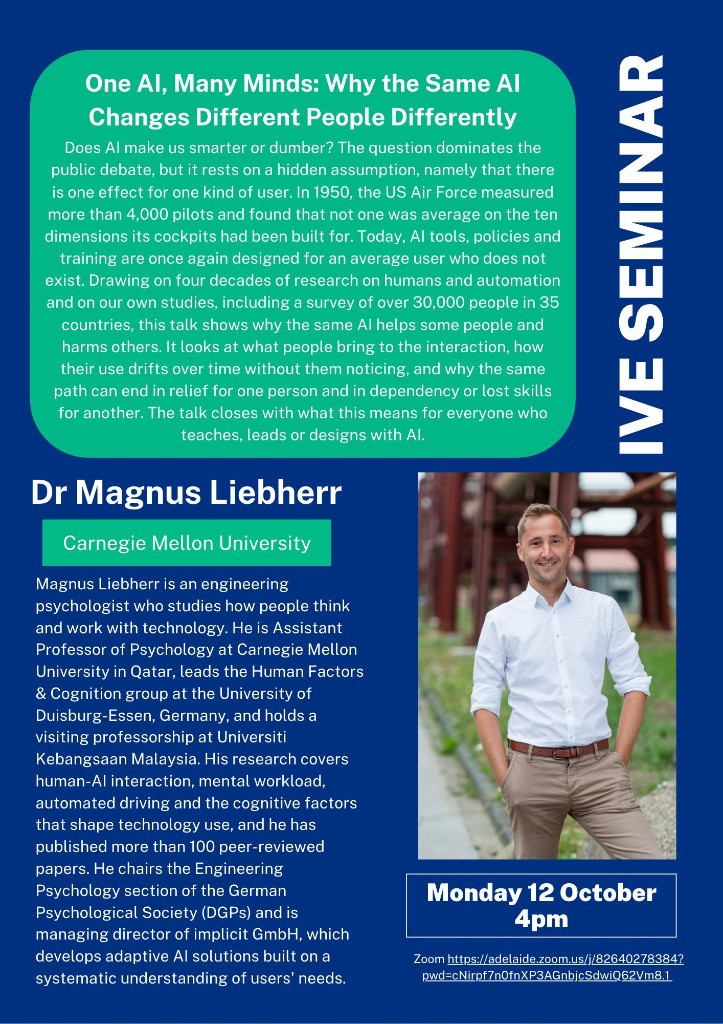
- Dr Magnus Liebherr, Carnegie Mellon University
- Date and Time:
- Monday 12 October 2026, 16:00 (Adelaide)
- Title:
- One AI, Many Minds: Why the Same AI Changes Different People Differently
- Location:
- Online (Zoom)
- Abstract:
- Does AI make us smarter or dumber? The question dominates the public debate, but it rests on a hidden assumption, namely that there is one effect for one kind of user. In 1950, the US Air Force measured more than 4,000 pilots and found that not one was average on the ten dimensions its cockpits had been built for. Today, AI tools, policies and training are once again designed for an average user who does not exist. Drawing on four decades of research on humans and automation and on our own studies, including a survey of over 30,000 people in 35 countries, this talk shows why the same AI helps some people and harms others. It looks at what people bring to the interaction, how their use drifts over time without them noticing, and why the same path can end in relief for one person and in dependency or lost skills for another. The talk closes with what this means for everyone who teaches, leads or designs with AI.
- Bio:
- Magnus Liebherr is an engineering psychologist who studies how people think and work with technology. He is Assistant Professor of Psychology at Carnegie Mellon University in Qatar, leads the Human Factors & Cognition group at the University of Duisburg-Essen, Germany, and holds a visiting professorship at Universiti Kebangsaan Malaysia. His research covers human-AI interaction, mental workload, automated driving and the cognitive factors that shape technology use, and he has published more than 100 peer-reviewed papers. He chairs the Engineering Psychology section of the German Psychological Society (DGPs) and is managing director of implicit GmbH, which develops adaptive AI solutions built on a systematic understanding of users' needs.
- Online:
- Join online
-
GRS seminar
12 Oct 2026 · 16:00–17:00

- Speaker:
- Professor Simon Ratcliffe, Yuri Vilmanis and Ashley Harris
- Date and Time:
- Monday 12 October 2026, 16:00–17:00 (Adelaide)
- Title:
- AI/ML Tool Use in Industry
- Location:
- CE: Ingkarni Wardli 5.57 (IW5.57); ML: Mawson Lakes Building J, J2-15
- Abstract:
- Maptek is an Adelaide-headquartered multi-national technology company developing software for the mining industry. Software Engineering within a commercial environment on large code bases provides challenges for state-of-the-art agentic coding tools and the humans responsible for guiding them. Some of these challenges, due to context size and job scale, are not apparent with clean-start and/or smaller code bases. These will be discussed — and effective approaches taken by engineers to deal with them — as well as lessons still being learnt. This is also an opportunity to ask senior engineers what working on code in a technical commercial environment is like in 2026 and how things are changing.
- Bio:
- Presenting will be Simon Ratcliffe (Professor of Practice in Software Engineering at Adelaide University and Head of Experimentation and Technology at Maptek), Yuri Vilmanis and Ashley Harris (Senior Software Engineers and AI Adoption Board founding members at Maptek).
-
Candidature review
13 Oct 2026 · 11:00
- Candidate:
- Jingyu Duan
- Supervisor:
- A/Prof Wei Zhang, Dr Xin Yuan
- Date and Time:
- Tuesday 13 October 2026, 11:00 (Adelaide)
- Title:
- Intent-Aware Model Predictive Control for Assistive Robotics
- Abstract:
- Assistive robots need to adjust their motion as task goals change, while respecting physical constraints and limits on online computation. Model predictive control (MPC) can plan motions under these requirements, but its decisions depend on when the control plan is updated, how well the dynamics model represents behaviour near constraints, and how information about the person enters the control process. This research examines these three aspects within an MPC framework. It estimates the expected benefit of re-solving MPC relative to continuing the current plan, and uses this estimate to guide update timing. It also investigates whether supervising a learned dynamics model with constraint-related action corrections can improve control decisions near constraints. In assistive tasks, changes in beliefs about a person’s goal will be used to evaluate whether the remaining plan is still suitable. Together, these investigations aim to improve task performance and constraint handling while making effective use of online computation.
- Location:
- Online (Teams; passcode bj7Jy7Pg)
- Microsoft Teams meeting:
- Join Teams meeting
-
Special session
14 Oct 2026 · Time TBC
- Speaker:
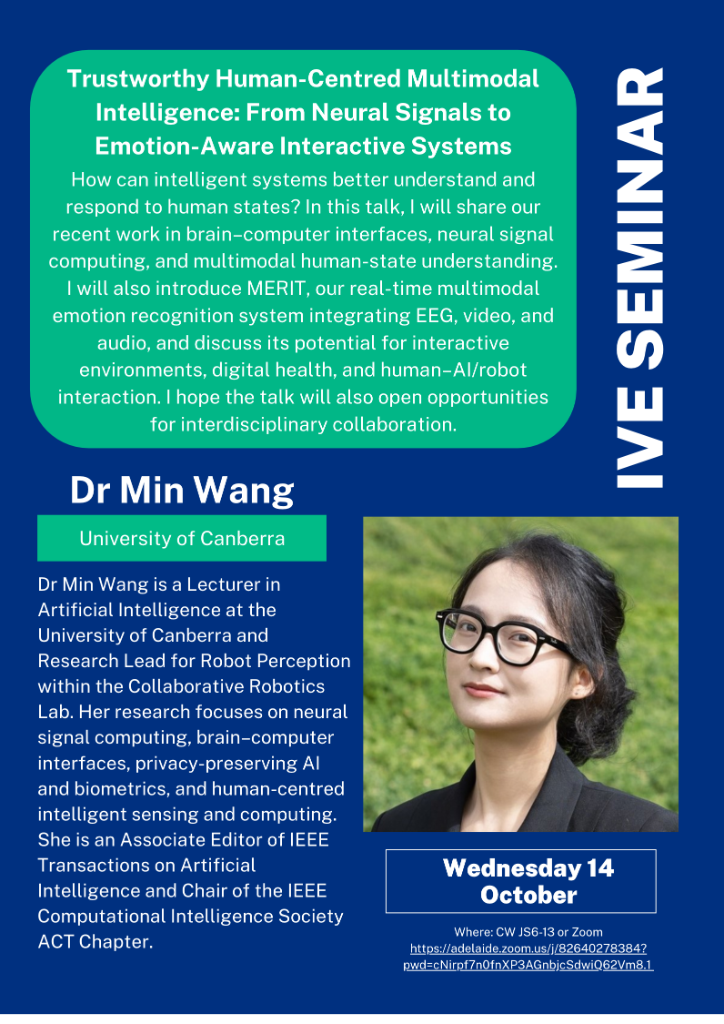
- Dr Min Wang, University of Canberra
- Date and Time:
- Wednesday 14 October 2026, Time TBC (Adelaide)
- Title:
- Trustworthy Human-Centred Multimodal Intelligence: From Neural Signals to Emotion-Aware Interactive Systems
- Location:
- City West, Jeffrey Smart Building, JS6-13 (also Zoom)
- Abstract:
- How can intelligent systems better understand and respond to human states? In this talk, I will share our recent work in brain–computer interfaces, neural signal computing, and multimodal human-state understanding. I will also introduce MERIT, our real-time multimodal emotion recognition system integrating EEG, video, and audio, and discuss its potential for interactive environments, digital health, and human–AI/robot interaction. I hope the talk will also open opportunities for interdisciplinary collaboration.
- Bio:
- Dr Min Wang is a Lecturer in Artificial Intelligence at the University of Canberra and Research Lead for Robot Perception within the Collaborative Robotics Lab. Her research focuses on neural signal computing, brain–computer interfaces, privacy-preserving AI and biometrics, and human-centred intelligent sensing and computing. She is an Associate Editor of IEEE Transactions on Artificial Intelligence and Chair of the IEEE Computational Intelligence Society ACT Chapter.
- Online:
- Join online
-
GRS seminar
19 Oct 2026 · 16:00–17:00

- Speaker:
- Professor Florian 'Floyd' Mueller, Monash University
- Date and Time:
- Monday 19 October 2026, 16:00–17:00 (Adelaide)
- Title:
- Experiencing the Body as Play through Human-Computer Integration
- Location:
- CE: Ingkarni Wardli 5.57 (IW5.57); ML: Mawson Lakes Building J, J2-15
- Abstract:
- To date interacting with computers mostly means focusing outwards, on the environment, rather than inwards, into the human body. However, bodily creativity such as expressed in sports teaches us how powerful experiences can be if the active human body is put center-stage. In consequence, I propose a body-centric human-computer integration (rather than interaction) agenda that stresses bodily play as a core human value: I call it “Experiencing the Body as Play”. I argue that this can facilitate novel alternative approaches addressing some of today’s most pressing health issues, such as physical inactivity, obesity and mental health. I illustrate this thinking by presenting recent work, including green-light aware eBikes, wireless pills and headphones that allow you to listen to your gut, literally.
- Bio:
- Florian 'Floyd' Mueller is Professor of Future Interfaces at Monash University (Melbourne, Australia), where he leads the award-winning Exertion Games Lab. Previously, he was at RMIT, Stanford, University of Melbourne, Microsoft Research, MIT Media Lab, Fuji-Xerox Palo Alto Labs, Xerox Parc, and industrial research organization CSIRO. He was the first Australian-based researcher to be selected to co-chair the CHI conference: HCI’s highest-ranked publication outlet. Floyd is an ACM Distinguished Member and has been elected to the prestigious ACM SIGCHI Academy, an honorary group of leaders “who have made substantial contributions to the field of HCI”. Website: http://exertiongameslab.org
GRS Series 2026 (full program) → · All upcoming seminars · Past seminars